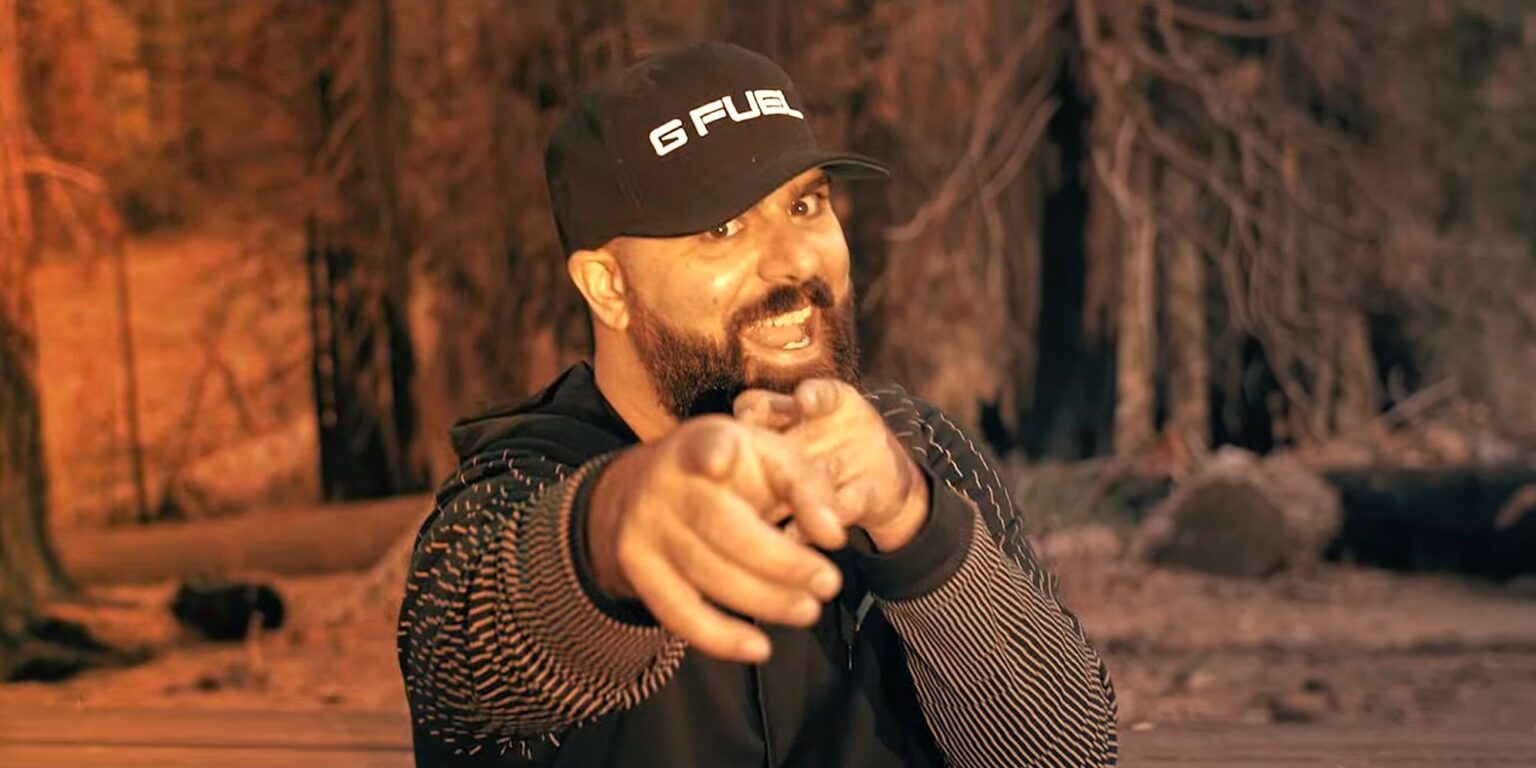
Keemstar vs. the internet: Who will win this neverending Twitter battle?
You might remember the YouTube news legend Keemstar, but what you might not know is that he is actually calling out a couple of influencers for some of their allegedly awful situations. Keemstar is reportedly ready to prove why Def Noodles is allegedly”getting stories wrong”. Well, let’s see what else the YouTuber has to say.
Dear , Def Noodles , Ethan , Trisha pic.twitter.com/ONTsH3mWYH
— KEEM 🍿 (@KEEMSTAR) April 7, 2021
Who is Keemstar?
Keemstar is known to report on everything & anything that’s going on in pop culture or as he refers to it as “social interactions online” which is great if you’ve been living under a rock and need that extra bit of information.
The YouTuber’s channel DramaAlert gives everyone updated information about celebrities like Logan Paul, TikTok star Bryce Hall, and even Snoop Dog. With a following of approximately 5.79 million subscribers, Keemstar is definitely getting his voice heard.
Imagine publicly tweeting this 😂😂😂
“ victim blaming even if the allegations aren’t true”
WHAT? How the hell is the person a victim if the allegations aren’t true??? pic.twitter.com/fqR4kztqq3
— KEEM 🍿 (@KEEMSTAR) April 11, 2021
DramaAlert with Jake Paul
Even though Keemstar admitted that he has doubts about the situation with fighter Jake Paul, he told his Twitter followers that he would wait until there was more evidence before he reports anything more about the story. However, Keemstar didn’t stay quiet when a Twitter user retweeted his video about waiting for more evidence. They claimed: “Victim blaming at the finest. This is so weird.”
Keemstar quickly replied to the Twitter user and stated: “WHAT? How the hell is the person a victim if the allegations aren’t true???”
Since then, Keemstar has been promoting Jake Paul’s brother Logan Paul on his Twitter & YouTube channel regarding his fight on WWE .
Hahahahahha Def Noodles posted another FAKE James Charles victim!
The so called victim uploaded a TikTok admitting it was fake. And Deff Noodles reported it on Twitter! 😂😂😂😂😂😂 pic.twitter.com/9anYzNyAUT
— KEEM 🍿 (@KEEMSTAR) April 11, 2021
DramaAlert with James Charles
When it comes to investigating a story online, Keemstar seems to be the YouTuber for the job, especially when it comes to James Charles and his serious harassment claims. According to a tweet by Keemstar: “Def Noodles posted another Fake James Charles victim! The so called victim uploaded a TikTok admitting it was fake. And Deff Noodles reported it on Twitter.”
Since Keemstar was disappointed with Def Noodles, he later tweeted: “#DefamationNoodles.”
Last Night Def Noodles posted another (FALSE) James Charles victim. With 2 mins of research anyone would know it’s fake. Def Noodles left the false allegation up on Twitter for 4 hours after he knew it was fake! Today the guy admitted it! pic.twitter.com/QXXh8Lmse8
— KEEM 🍿 (@KEEMSTAR) April 11, 2021
Now, it seems that after the set of allegations made from a TikTok video against James Charles for allegedly grooming another teen, Keemstar has quickly tweeted the video of the teen who posted the TikTok video and admitted that the allegation was indeed “fake”. Keemstar tweeted that “Def Noodles left the false allegation up on Twitter for 4 hours after he knew it was fake”.
Keemstar posted the video where the teen actually admitted what happened. The teen stated how apologetic he was towards the “James Charles situation” as it was “fake”. He claimed: “It was my stupid . . . stupid and irresponsible idea to even do that. To try to ruin someone elses career and try to gain clout in a way. But honestly I’m so sorry from the bottom of my heart.”
Just got off the phone with Bryce Hall he says all the early reports are wrong! He clearly beat Stromedy , says Stromedy only got 1 good Jab on him. And Stromedy ran out of gas refused to fight round 2 #DramaAlert ! pic.twitter.com/JDKZ4lBiQ4
— KEEM 🍿 (@KEEMSTAR) April 9, 2021
DramaAlert with Byrce Hall
On the other hand, Keemstar commented on April 9th about the fight between TikToker Bryce Hall and YouTuber Stromedy, before Bryce Hall takes on Austin McBroom, however Bryce Hall’s comments have been quite interesting, and source claimed that “Even Bryce Hall’s coach was calling it a draw cus he knew Bryce lost.” Ouch. However, Keemstar tweeted: “Just got off the phone with Bryce Hall he says all the early reports are wrong! He clearly beat Stromedy . . .”
Keemstar continued: “(Hall) says Stromedy only got 1 good Jab on him. And Stromedy ran out of gas refused to fight round 2 #DramaAlert!”
Keemstar vs. the internet: who will win this never-ending Twitter battle? (2026 update)
By 2026, the ongoing conflict between Keemstar and “the internet” has become less of a feud and more of a permanent condition. What began years ago as sporadic controversies has hardened into a cyclical dynamic: provocation, backlash, partial retreat, escalation, repeat. The question is no longer whether Keemstar will be “canceled,” but why this particular conflict refuses to resolve.
Keemstar’s online persona was forged in confrontation. As the longtime face of YouTube drama commentary, his brand has always relied on antagonism, speed, and emotional intensity. Outrage is not collateral damage; it is the fuel. Twitter—now fully entrenched as a battleground rather than a conversation space—remains the ideal arena. Short form. High visibility. Low context. Maximum volatility.
The internet, however, has changed. In the mid-2010s, backlash functioned as a blunt instrument: public shaming, advertiser pressure, and platform enforcement could meaningfully disrupt careers. By 2026, outrage is both more frequent and less decisive. Attention cycles are shorter. Audiences are fragmented. Platforms are inconsistent. The result is a strange stalemate where conflict generates noise but rarely final outcomes.
Keemstar has adapted to this environment better than many of his critics would like to admit. He no longer appears surprised by backlash; he anticipates it. Tweets are framed to provoke response. Apologies, when issued, are calibrated to minimize concession. Retreats are temporary. This is not accidental. It reflects an understanding that perpetual controversy keeps him relevant even when it damages reputation.
At the same time, the internet’s response has become ritualized. Each flare-up follows a familiar script: screenshots circulate, old clips resurface, moral lines are redrawn, and calls for deplatforming trend briefly. Then attention shifts. The structural problem is that the internet lacks a unified endgame. There is no single authority capable of delivering a definitive “win.”
Platform governance has also muddied the waters. Enforcement is uneven and opaque. Some actions trigger penalties; others do not. This inconsistency feeds conspiracy narratives on all sides and allows figures like Keemstar to frame themselves as selectively targeted rather than broadly accountable. In 2026, platform moderation is less about ethics than risk management, and users sense the difference.
Another factor is audience bifurcation. Keemstar’s critics and supporters largely inhabit different algorithmic worlds. Outrage rarely reaches those predisposed to dismiss it, while defenders rarely persuade skeptics. This echo-chamber effect ensures that no amount of collective condemnation fully dislodges his base. The internet is loud, but it is not unified.
There is also the uncomfortable reality that conflict culture rewards endurance. Keemstar has outlasted multiple waves of criticism simply by staying present. In an ecosystem where memory is short and novelty is prized, persistence becomes a form of power. Each controversy becomes just another data point rather than a breaking moment.
By 2026, the battle has shifted from morality to fatigue. Critics are no longer shocked; they are exhausted. Supporters are no longer defensive; they are accustomed. The conflict sustains itself not because it escalates, but because it never concludes. This is arguably the most revealing aspect of the saga. The internet is excellent at reacting and poor at resolving.
So who is winning? If victory is defined as moral authority, the internet would argue it holds the upper hand. If victory is defined as continued visibility, Keemstar remains firmly in the game. Neither side achieves total dominance because the system itself discourages finality. The platforms benefit from engagement. Audiences benefit from spectacle. The conflict persists because it is functional.
In 2026, Keemstar vs. the internet is less a battle than a feedback loop. He provokes because attention follows. The internet reacts because outrage performs. Platforms host because traffic converts. No participant has sufficient incentive to end the cycle.
The most likely outcome is not a decisive win, but normalization. Controversy becomes background noise. Each new flare-up registers slightly less impact than the last. The fight continues, not because it matters more, but because it matters just enough to keep going.
In that sense, the internet may never “win” in the way it imagines—and Keemstar may never lose in the way his critics hope. The battle endures because it is structurally unresolved, not because either side lacks conviction.
—
Do you think Keemstar is going to win the online battle against Def Noodles? Did Bryce Hall actually lose the fight? Check out what else Keemstar has to say on his channel and let us know in the comments below.