Gothtober: Crawl into the the creepiest cold case files left for dead
October rolls around and Film Daily kicks off Gothtober with a fresh look at the creepiest cold case files still waiting for answers. These stories have appeared on Unsolved Mysteries and filled true-crime books, yet they continue to unsettle anyone who digs into the details. Some involve long-silent houses, others remote farms or suburban streets where children vanished. The following accounts mix documented facts with lingering questions that refuse to fade.
The Watcher
The Broaddus family bought the Dutch colonial at 657 Boulevard in Westfield, New Jersey, expecting quiet suburban life. Within days a letter arrived from someone calling himself The Watcher. The writer claimed his family had watched the property since the 1920s and now demanded to know why the new owners had brought their children, referred to as young blood, to the house. Subsequent letters threatened the family and asked whether they had moved in out of greed. Private investigators, security cameras, and police reports produced no arrests. The Broadduses sold the home in 2019 for roughly nine hundred fifty-nine thousand dollars and moved elsewhere in town. The new owners have reported no further contact. The case stays open though inactive, and a 2022 Netflix series loosely dramatized the events without resolving them.
The man in the septic tank
In 1977 a farmer outside Edmonton, Alberta, discovered a decomposed leg protruding from an abandoned septic tank on a neighboring property. The victim had suffered repeated gunshot wounds, burns from a blowtorch and cigarettes, severe beatings, and sexual mutilation before being dumped headfirst into the tank and covered with lime. Forensic work at the time could only establish that the man was Indigenous and between twenty and forty years old. In 2021 genetic genealogy through Othram labs identified him as Gordon Edwin Sanderson, a twenty-six-year-old from Manitoba living in Edmonton. Alberta RCMP continue to treat the homicide as active and still seek information about Sanderson’s final days. The identification closed one long-standing gap but left the question of who carried out the prolonged torture unanswered.
The snow killings
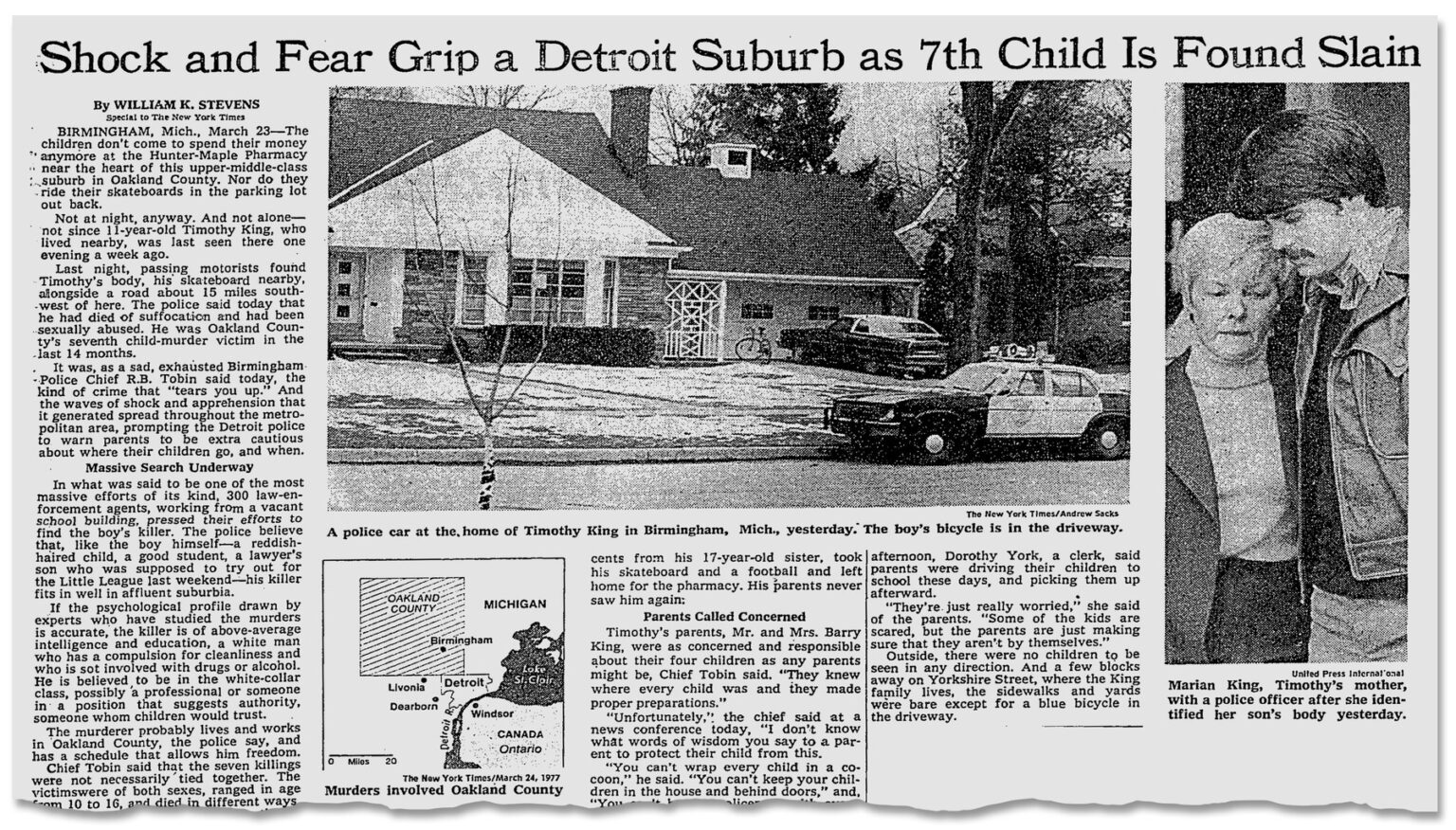
Between February 1976 and March 1977 four children aged ten to twelve disappeared from suburban Oakland County, Michigan. Mark Stebbins, Jill Robinson, Kristine Mihelich, and Timothy King were each found dead in snowbanks or roadside ditches. Police mounted one of the largest manhunts in state history and uncovered two separate child-exploitation networks, one on North Fox Island in Lake Michigan and another in Detroit’s Cass Corridor. Retired Detroit News columnist Rich Keenan later noted the public reluctance to accept that such crimes could occur in affluent suburbs. A 2009 polygraph lead involving a convicted pedophile who was the son of a General Motors executive produced no charges; the man died before his name surfaced publicly. As the fiftieth anniversary of the first murder approached in 2026, Michigan State Police assigned the case to special units still evaluating DNA and artificial-intelligence tools on preserved evidence. The investigation remains open with no resolution.
The Fall River mansion
The 1892 double homicide of Andrew and Abby Borden in Fall River, Massachusetts, produced the familiar nursery rhyme and an acquittal for their daughter Lizzie. Because no one else was convicted, the case technically stays unsolved. Since 2021 the house has been owned by Lance Zaal through US Ghost Adventures. It operates as a bed-and-breakfast offering overnight stays, guided tours, and paid ghost hunts. Staff and visitors continue to report creaks, footsteps, and cold spots on the second floor where the murders occurred. The property draws steady paranormal tourism while the original crime file gathers dust in city archives.

Hinterkaifeck Farmhouse Murders
In March 1922 six people living on an isolated farm near Waidhofen, Germany, were killed with a mattock inside their own home. Days earlier the family had noticed footprints in fresh snow leading to the house but none leading away. Strange sounds in the attic prompted the patriarch to search the space, yet he found nothing. After the murders investigators determined the killer had likely hidden in the attic for several days, eating stored food and watching the family before striking. The case produced no arrests and remains one of Germany’s most disturbing unsolved crimes.

Villisca Axe Murders
On the night of June 9, 1912, an intruder entered a modest house in Villisca, Iowa, and killed eight people, six of them children, while they slept. The killer used an axe found in the backyard, covered every mirror in the house, and draped sheets or clothing over each victim. Some evidence suggested the attacker remained inside the home for hours after the murders. Despite a lengthy investigation and multiple suspects, no one was convicted. The restored house now offers tours that highlight the ritualistic details still debated by researchers.

Recent Genetic Genealogy Cold Case Breakthroughs
Advances in consumer DNA databases have altered the trajectory of several long-dormant investigations. The same genetic genealogy methods that identified Gordon Sanderson in 2021 have produced identifications in dozens of other cases across North America during the 2020s. Law-enforcement agencies now routinely submit unidentified remains and unknown suspect profiles to private labs when traditional leads have stalled. While the technique raises privacy questions, it has delivered answers to families who waited decades without closure.

Unsolved Mysteries Netflix Updates
The Netflix reboot of Unsolved Mysteries has released five volumes through 2024, each mixing disappearances, murders, and reported paranormal events. The series continues to draw new tips on older cases and keeps public attention on files that might otherwise sit untouched. While none of the four original cases profiled here have received dedicated episodes in the reboot, the show’s format mirrors the same blend of documented evidence and lingering questions that originally drew viewers to the franchise.
These stories persist because the questions they raise refuse tidy answers. Whether the crimes occurred on remote farms, suburban streets, or inside historic homes, each file still waits for the piece of evidence or testimony that could finally close it. Until then, the details remain available for anyone willing to look, and the chill they produce lingers long after the last page or screen goes dark.