‘Black Mirror’ S4E1: “Crocodile”
Black Mirror by this point needs no introduction. It’s gone from a Channel 4 sleeper hit to a pop culture sensation. Its maestro, Charlie Brooker, once wrote small series for the BBC and had a column for the Guardian. Now, he’s got a few Emmys to his name and a deal with Netflix. Black Mirror explores technology from either now, a few seconds from now, or years ahead. It presses dark human immorality and existentialism up to a black screen, cracking upon the impact of misery. The series is likened to a modern take of The Twilight Zone in replicating its feeling of pure discomfort when faced with a world-view altering story. Black Mirror has a point though, not just about technology but about human nature. You’re revolted, turned off, sickened by the end – but that doesn’t mean you’re going to stop watching. Philosophically bombastic situations were launched in previous series, and their ambition was scaled up in the transfer to Netflix, along with their budget, appeal and casting calls. Series four of Black Mirror has little relation to any narrative thread running beforehand – each episode is a standalone comment on humanity & tech. While the third season was home to such show-stoppers like “San Junipero” and “Shut Up and Dance”, two episodes failed to connect. “Playtest” and “Men Against Fire” wandered too far into referential rabbit holes, meandering around a clunky message. Series four brings both good and bad news. Every episode unravels an idea, stretches its potential to a logical point, and ends in (usually) total trademark bleakness. But while the overall consistency is enjoyably unsettling, series four lacks the shocking pivot point “OMG moments” of previous outings. In totality, Black Mirror is still one of the best shows you shouldn’t simply binge watch. Seriously, we had to walk our dogs or have a lie down after some episodes. It’s still rife with ballistic collisions of ideas, tones, and stories. There’s some incredible casting work this season, with Maxine Peake (The Theory of Everything), Letitia Wright (My Brother the Devil), and Cristin Milioti (The Wolf of Wall Street) all stand-outs. This series is much more politically charged than other seasons, which works well with the world’s current social climate. Black Mirror’s latest is a nice complement to all the Christmas cheer you’ll be experiencing – have a bit of bleak nihilism to wash down the aftertaste of turkey dinners and gift wrap! We’ll be reviewing each episode of season four, trying incredibly hard to avoid spoilers as we circumnavigate them. Black Mirror season four is essential viewing, if a little lacking in the emotional punches of season three. If you want to go in completely blind, however, then stop reading right now.
“Crocodile”
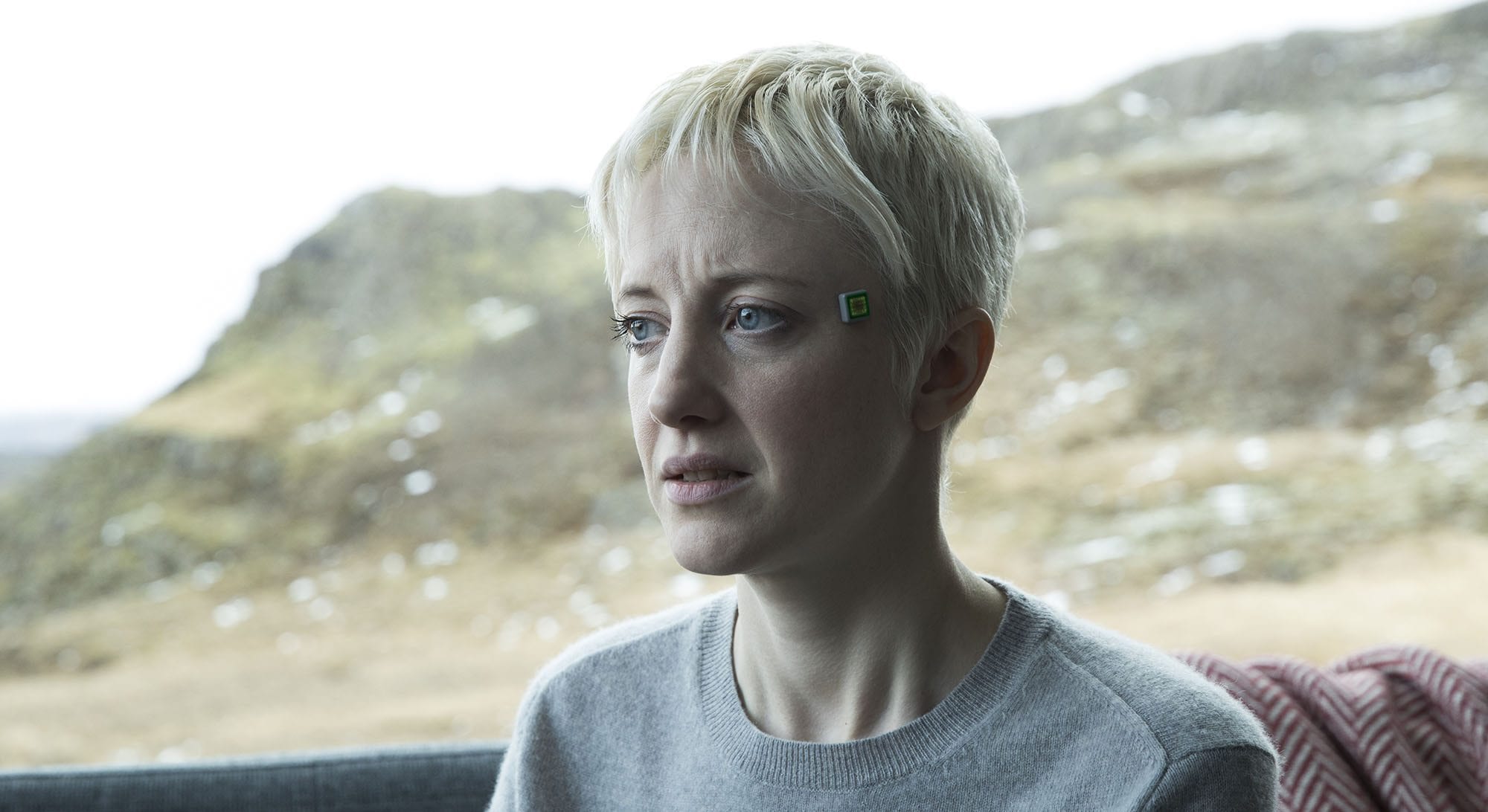
Logline: A story about memory, remorse, and the lengths someone goes to protect a misdeed. Verdict: This story puts a woman (Andrea Riseborough) at the center of a tale that weaves through time & memory. She commits an act that could potentially ruin her entire life, so takes extreme measures in light of her desperate circumstances, showing off the truly dark underbelly of the human psyche, along with Black Mirror’s trademark black humor. What starts off as an unnerving story about covering something up unfortunately turns into a bit of a retread. The technology explored here is a bit too familiar to “The Entire History of You” from season one, and as that was the only episode written entirely without Charlie Brooker, one feels this is his attempt to take those themes in his own direction. But its hefty drama doesn’t save it from predictability. When Kiran Sonia Sawar’s character enters, a series of obvious setups ensue to break momentum. There is some memory rejigging, but without incisiveness. Sawar delivers a heartbreaking set of scenes in this episode, and Riseborough manages to show the physical sensation of internal mental collapse extraordinarily well – it’s just a shame the characters’ motivations are never quite explored or explained. Hillcoat’s direction manages to splice together a neat structure to the whole episode, finding cold comfort in the washed-out aesthetic. One of the side stories actually deals with some of the central themes more neatly – a sign of insufficient screenplay development. The episode received mixed reviews and often ranks lower in season 4 lists, with consensus on excessive bleakness. The Recaller device projects subjective visual memories prone to error rather than exact recordings, and the story functions primarily as a human-sin crime drama with Nordic noir elements.
Production and Filming Details
Filmed in Iceland; first draft featured male protagonist and Scotland setting. Inspired by Nordic noir and the memory tech from The Entire History of You. Cinematography by Lol Crawley; running time approximately 59 minutes. The remote, snowbound locations gave the production team a stark canvas that matched the episode’s mood without forcing artificial frost onto sets. Brooker reworked the script after early notes suggested the colder climate would sharpen the isolation at the story’s core. Crawley’s lens kept faces in tight frames against wide white horizons, letting silence and wind do much of the heavy lifting. Those choices kept the visual language economical while still signaling that every character was already cornered before the first line of dialogue landed.
Critical Reception and Legacy
53% on Rotten Tomatoes with a 6.39/10 average from 19 critics. Described as beautiful but blunt with shallow nihilism. Mixed reviews criticize excessive violence and predictable twists while praising acting and aesthetic. Frequently ranks low in season 4 and series-wide lists but noted for memorability. Later rankings through 2025 continue to place the episode near the bottom of season four compilations, yet several critics still cite Riseborough’s unraveling as one of the season’s most unsettling performances. The conversation has settled on the idea that the episode’s strength lies less in fresh ideas than in the unflinching execution of familiar ones.
Thematic Focus: Human Nature vs. Technology
Recaller shows subjective, imperfect memories unlike exact grain recordings, highlighting fallibility. Story functions more as a crime thriller about escalating cover-ups than a deep tech critique. Recurring Black Mirror motif of the song Anyone Who Knows What Love Is and cross-episode Easter eggs appear. The device becomes a plot trigger rather than the central argument, shifting attention toward how ordinary people rationalize each new moral compromise. That emphasis on personal accountability over gadget commentary gives the hour a leaner, meaner tone than some viewers expected from the memory-tech premise.
Episode Title Origin and Symbolism
Title refers to a pivotal critical event that leaves the protagonist living in constant fear and unable to fully enjoy life. Brooker intended it to symbolize the inciting incident triggering Mia’s spiral of desperation. The image works as shorthand for a wound that never heals and keeps surfacing in the worst possible moments. It also quietly nods to the way one decision can snap shut around a life the same way jaws close on prey, leaving little room for later escape.
Across its hour, Crocodile trades spectacle for a slow tightening of consequences that leaves little daylight between guilt and survival. The performances remain the clearest reason to revisit the episode, even when the tech elements feel more borrowed than reinvented. Its place in the season four conversation has held steady as a cautionary footnote rather than a standout, yet the cold precision of its execution keeps it lodged in memory long after the credits roll.