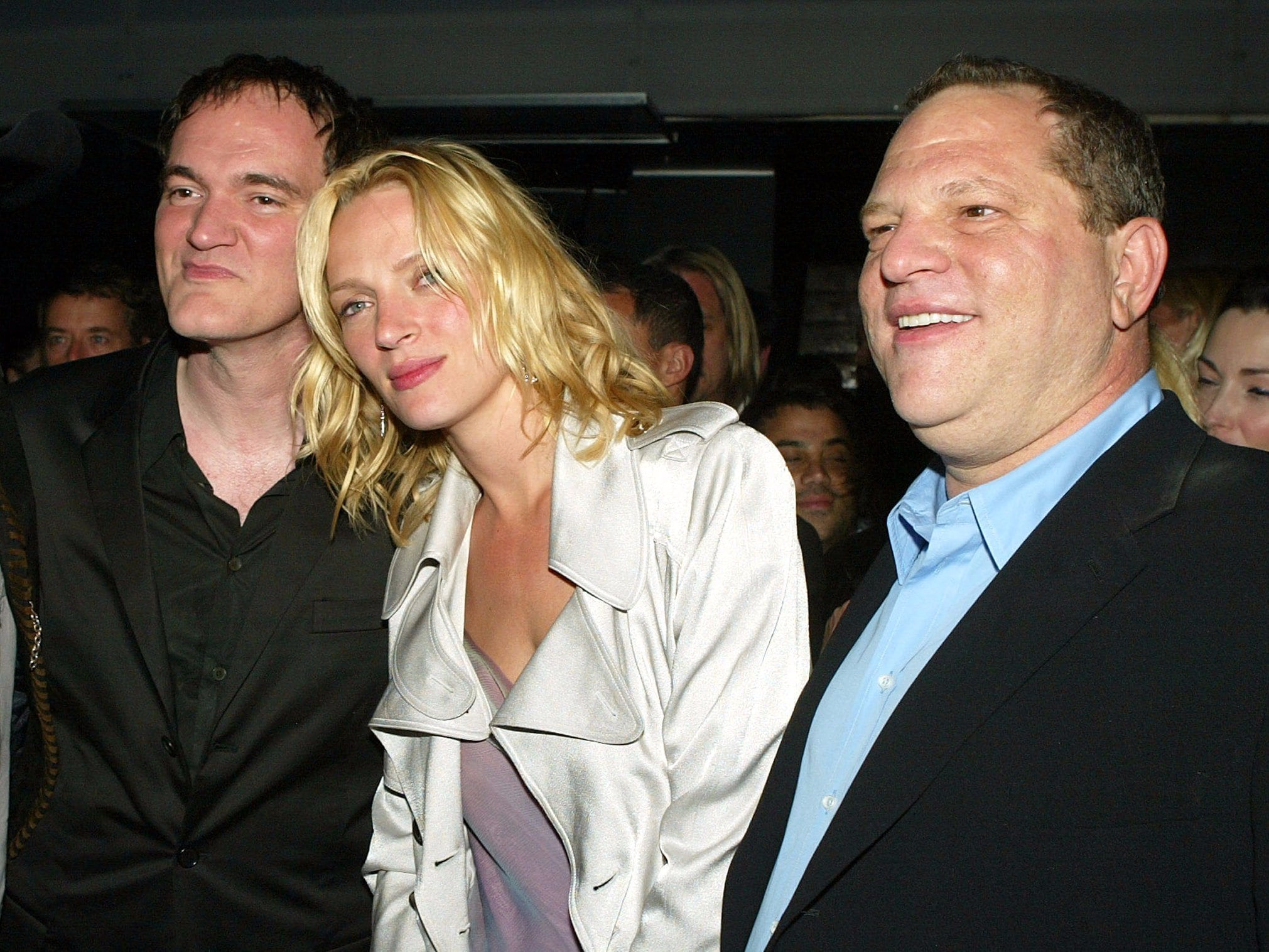
#MeToo: Everything we learned from Uma about the Weinstein Company boys’ club
In a November interview with Access Hollywood, actor Uma Thurman revealed she was “waiting to feel less angry” until she could talk about sexual harassment and assault in Hollywood – a moment that appears to have arrived this past weekend. On February 3, The New York Times published an interview between Thurman and Maureen Dowd in which the powerhouse actor shared harrowing allegations of sexual misconduct against Harvey Weinstein and chilling claims of an abrasive working relationship with Quentin Tarantino. Thurman’s career was arguably launched by her performance as Mia Wallace in Tarantino’s 1994 indie hit Pulp Fiction. Around a decade later, she further cemented her status as a ferocious screen icon playing Beatrix Kiddo, the vengeful bride of Tarantino’s Kill Bill Vols 1 & 2. Thurman was the golden girl of the Weinstein Company as it enjoyed its first major financial success from Pulp Fiction. She was also regarded as Tarantino’s muse, the director describing their “auteur-muse” relationship as an “Alfred Hitchcock-Ingrid Bergman legend.” However, as the article suggests, “. . . beneath the glistening Oscar gold, there was a dark undercurrent that twisted the triangle.” Here’s everything we know about Thurman’s allegations in this developing story.
Weinstein allegedly sexually assaulted Thurman in London
Thurman described how she “didn’t feel threatened” during a strange argument in Paris she claims ended with Weinstein throwing on a bathrobe and leading her to a steam room. Calling the spectacle “ridiculous”, Thurman alleged Weinstein got “very flustered and mad and he jumped up and ran out.” Not long after this, Thurman reported the next alleged encounter was more physical, “such a bat to the head”. She explained: “ . . . he pushed me down. He tried to shove himself on me. He tried to expose himself. He did all kinds of unpleasant things.” According to Thurman, Weinstein sent a “26-inch-wide vulgar bunch of roses” to her the next day with the note: “You have great instincts.”
Weinstein allegedly threatened to “derail” Thurman’s career
Thurman was apparently assured by Weinstein that the previous encounter was a misunderstanding. The actor claimed she warned Weinstein, “If you do what you did to me to other people you will lose your career, your reputation and your family, I promise you.” Though Thurman’s memory of the incident that followed her warning is described as “abruptly” ending there, a friend described how Thurman was “very disheveled and so upset and had this blank look” after leaving his room. When she was able to talk again, Thurman apparently divulged that Weinstein had threatened her career.
Weinstein’s behavior’s warning signs; Thurman feels bad about “all the women” he allegedly attacked after her
Thurman disclosed she and Weinstein knew each other for a long while before the first alleged attack took place; she even perceived him as her “champion”. Weinstein’s habit of “validating” her by “complimenting” her mind made Thurman possibly “overlook warning signs”: “. . . he had a chokehold on the type of films and directors that were right for me.” Thurman suggested that “Quentin used Harvey as the executive producer of Kill Bill, a movie that symbolizes female empowerment”, musing that young women were “lambs walked into slaughter” as a result. “They were convinced nobody rises to such a position who would do something illegal to you, but they do.” Thurman further lamented: “I am one of the reasons that a young girl would walk into his room alone, the way I did.”
Tarantino’s “animosity” with Weinstein affected creative relationship with Thurman
In 2001, around the the time they were trying to make Kill Bill, Tarantino apparently acknowledged how Thurman was acting “skittish” around Weinstein. Reminding him of the London incident, which Thurman suggested she’d already told him about, Tarantino apparently “confronted” Weinstein, who subsequently offered Thurman a “half-assed apology”.
Thurman experienced “dehumanization to the point of death” on the set of Kill Bill
With four days left of shooting, Thurman was apparently coerced by Tarantino to operate a car she didn’t feel comfortable driving on a difficult stretch of sand road. The director apparently instructed she “hit 40 miles per hour” so her hair would “blow the right way.” Thurman described the car as a “deathbox” with an improperly secured seat. In footage that apparently took Thurman 15 years to receive, the actor is shown struggling to drive the car before smashing into a palm tree. “The steering wheel was at my belly and my legs were jammed under me . . . . I felt this searing pain and thought, ‘Oh my God, I’m never going to walk again.’” The shot shows beaming with relief as she manages to step out of the car. The injuries Thurman sustained in the crash have apparently caused permanent damage to her neck and knees. Thurman explained Tarantino and Weinstein turned on her after the accident. “I went from being a creative contributor and performer to being like a broken tool.” Tarantino allegedly performed some of the “sadistic flourishes” of Kill Bill himself, such as spitting in her face – in place of Michael Madsen’s character – and choking Thurman with a chain for another scene involving the character GoGo. Tarantino later stated he did not view the drive as a stunt and was irritated but not raging. Thurman posted the footage on Instagram noting negligence without malicious intent and Tarantino’s remorse.
Long-term impact on Thurman’s health and career
Thurman has described ongoing neck and knee issues from the crash in the 2018 account. No new contradictory information has emerged; injuries noted as permanent in original reporting. The crash left lasting physical effects that Thurman has referenced in later interviews, shaping how she approached physically demanding roles in subsequent years. Despite the injuries, she continued to work steadily across film and television, maintaining a selective but consistent presence on screen. The episode also highlighted safety standards on set that later came under greater scrutiny across the industry.
Tarantino’s 2018 response and reconciliation
Tarantino responded February 5, 2018, calling the stunt his biggest regret. He clarified in a Deadline interview that he did not view the drive as a stunt at the time. Thurman acknowledged his remorse and the provision of footage years later in her Instagram statement. Their public exchange offered a measure of resolution to the creative tensions that had surfaced in the original New York Times piece.
Weinstein’s legal proceedings after 2018
Weinstein did not pursue legal action against Thurman. He faced multiple trials in the years that followed. A 2020 conviction was overturned in 2024, followed by a retrial conviction in 2025 on a sexual assault count and additional sentencing in Los Angeles cases. In 2026, the Jessica Mann case was dismissed after mistrials, though other convictions stand. The legal arc illustrates how the initial wave of allegations translated into protracted courtroom proceedings.
Broader context of the Weinstein Company and #MeToo in 2018
Thurman’s allegations added to dozens already public by early 2018. The piece was part of the wave of disclosures that accelerated legal and cultural changes. Industry conversations about power imbalances and workplace protections gained momentum quickly after the story broke. Studios and agencies began revisiting internal policies, and the moment marked a shift in how allegations from high-profile talent were received and reported.
Thurman’s account remains the primary source from the 2018 New York Times interview, with no new public allegations or statements from her regarding Weinstein or the interview in recent years. The documented responses from Tarantino and the subsequent legal developments around Weinstein provide a fuller picture of how the original allegations unfolded in public view. The episode continues to sit within the larger record of the Weinstein Company era and the reckoning that followed.