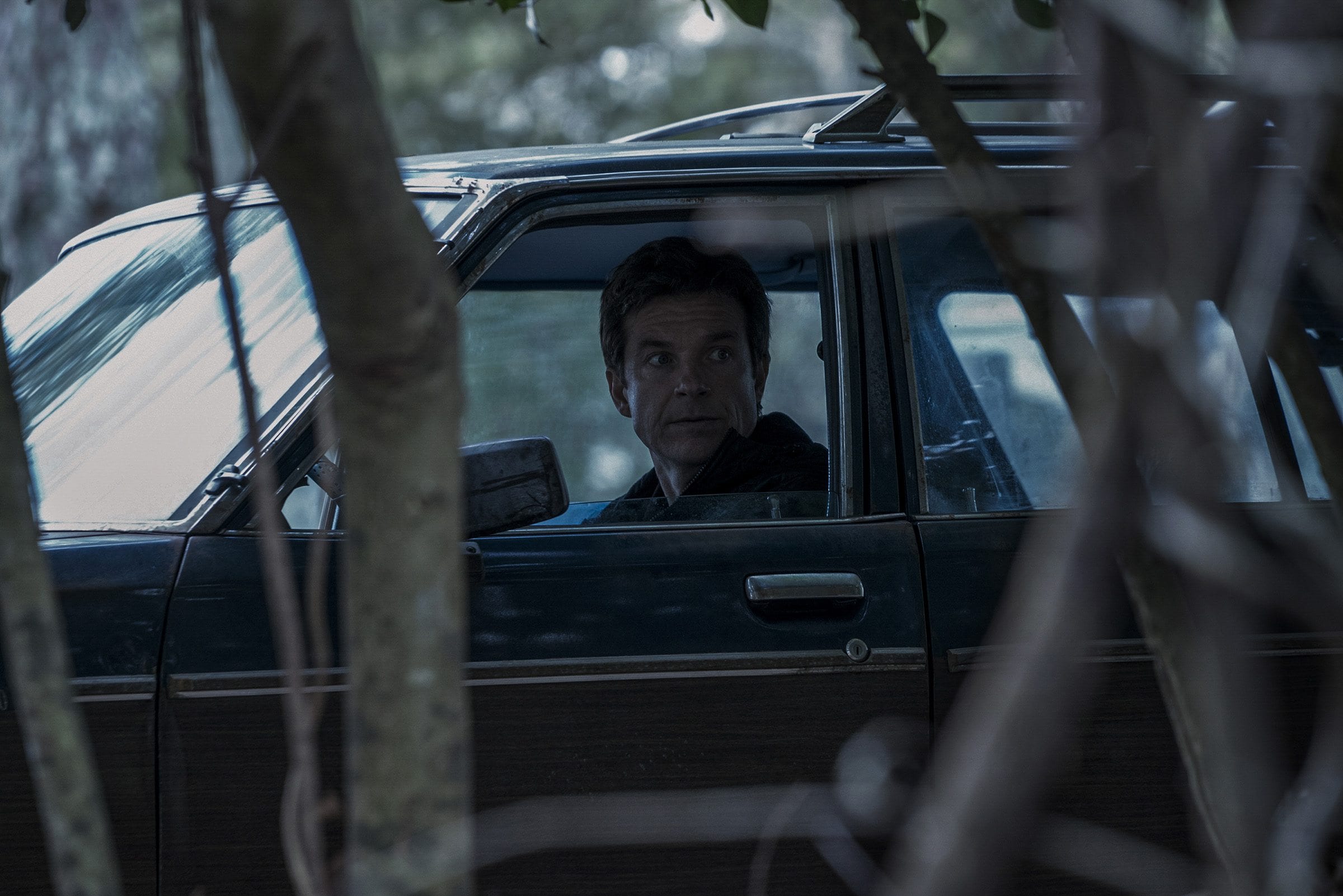
‘Ozark’ faces more than one darkness in “Tonight We Improve”
Darkness has always been one of the defining elements of Ozark, both in the literal sense of the lighting and in the moral territory the characters keep crossing. Episode four, titled “Tonight We Improvise,” leans into both versions of that shadow. The opening narration from Marty Byrde sets the tone, spelling out exactly how cartel cash moves through a cash-heavy business with flexible books and offshore accounts. That voiceover lands like a blunt accounting lesson before the first scene even begins.
The unexpected start features Marty (Jason Bateman) noticing his son Jonah (Skylar Gaertner) has picked up the odd habit of disemboweling animal carcasses. Wendy (Laura Linney), distracted by a plan to buy a fixer-upper for laundering funds, doesn’t realize something weirder than normal is going on with Jonah until Marty cuts off her speech about real estate and fills her in on Jonah’s new hobby. The two then hop on a boat to have a We Need to Talk About Kevin-style conversation about whether or not they’re the proud parents of a budding psychopath, unaware that, as sound carries across water, daughter Charlotte (Sofia Hublitz) can clearly hear everything they’re saying.
Money Laundering Mechanics and Narration
Marty’s opening monologue grounds the entire episode in the practical mechanics of moving dirty money. He explains how a strip club works as the perfect vehicle: high cash volume, adjustable receipts, and the ability to run payments through offshore accounts without raising immediate flags. The narration removes any glamour from the scheme and makes the stakes feel like a spreadsheet problem rather than a thriller flourish. That precision carries through the rest of the hour, turning every conversation about real estate or club ownership into a discussion of balance sheets and risk.
Ruth Langmore’s Strategic Heist Execution
That attempted subterfuge carries over to the main plot, where Marty ramps up his efforts to acquire the local strip club (and its laundering rackets) by putting more trust in Ruth (Julia Garner) even though she puts no effort whatsoever into covering up her contempt for him and desire to see him die, or at least fail. Marty might think his willingness to let Ruth take on more responsibility in his operation is because he has no reason to care what happens to her, but it’s more complicated than that. Whether he admits it or not, Marty seems to recognize on some level that, in order to survive this situation into which he’s gotten himself, he needs someone ruthless and conniving in his corner, and no one in his family remotely fits that bill.
Ruth negotiates her cut from ten percent up to twenty-five before she even starts planning. She recruits local teenagers to spend heavily at the club, then tips off the police about minors being served. The resulting raid gives her the opening to smash Bobby Dean during a supposed job interview and locate the safe containing the ownership documents. The sequence is quick, efficient, and entirely her show, leaving Marty to handle the cleanup while she walks away with a larger share of future profits.
Emergence of the Snells as Antagonists
Marty needs that more than he realizes, as his and Ruth’s theft of the strip club ownership documents from Bobby Dean (Adam Boyer) removes Bobby from the picture in more ways than one, and puts Marty & company in the crosshairs of yet another unseen enemy. With the cartel breathing down his neck about the slow movement of their funds and Agent Petty (Jason Butler Harner) now cozying up to Ruth’s kin, the last thing the Jenga tower that is Marty’s life needs is some new player with an impatient hand.
Bobby had been laundering for Jacob and Darlene Snell, a local couple running their own criminal operation. His sudden removal draws their immediate attention, and the episode ends with their decision to eliminate him for failing to protect their interests. The introduction expands the playing field beyond the cartel and the Byrdes, adding a pair of antagonists who operate with their own codes and their own leverage over the local economy.
Agent Petty’s Undercover Approach to the Langmores
Darkness motif and family dynamics continue to shape the personal side of the story. Jonah’s carcass habit turns out to be part of a school project studying how vultures feed, which eases some of his parents’ immediate concern. Later, Marty begins teaching him the basics of moving money through the club accounts, shifting their bonding from the earlier boat discussion to something more practical and more dangerous. Charlotte’s eavesdropping remains the clearest signal that the family’s secrets are already public within the household itself.
Agent Petty’s interest in Russ Langmore, Ruth’s uncle, develops as a parallel investigation track. Petty approaches the family under the guise of personal interest while gathering information on their finances and connections. The move sets up a law-enforcement subplot that runs alongside Marty’s schemes without yet intersecting directly, keeping the pressure on multiple fronts.
Marty-Ruth strip club acquisition and moral code reach their clearest test when Marty posts bail for Bobby and presents a two-hundred-thousand-dollar offer backed by the documents Ruth stole. He frames the deal as a fair transaction rather than outright theft, yet the gesture immediately unravels once the Snells decide Bobby is no longer useful. The sequence shows how quickly any attempt at maintaining a personal code collapses under the weight of the larger operation.
Here in the middle stretch, Ozark is biding its time, not asking us to sympathize with Marty or even begrudgingly admire him the way so many did with Walter White. Ozark instead asks us to look long and hard into the darkness surrounding Marty and his family and see what stares back. The central question in Ozark increasingly seems not to be “How do you break a basically good man?”, but “How many people will a man hurt before he admits he never had a soul to sell in the first place?”