Zooey Deschanel being quirky: Why ‘New Girl’ is still the absolute worst
We’re not one to kick a lady while she’s down (or in this case, a TV show currently airing its final ever season), but we’ve been ever so polite about something majorly vexing for a while now – New Girl is bad, folks. Really, really bad.
We aren’t just saying this to kick up a stink (honest); we’re saying it because we checked back in with the show recently after giving up on it a couple of seasons ago and it was like nothing had changed. All time-hopping aside (which, by the way, is a cheap enough final season TV gimmick as it is), the show is still clunking about with the same flaws, bad jokes, stagnant characters, and saccharine tweeness that it was in season one. New Girl is the absolute worst and we won’t be sad to see it go. Here’s why.

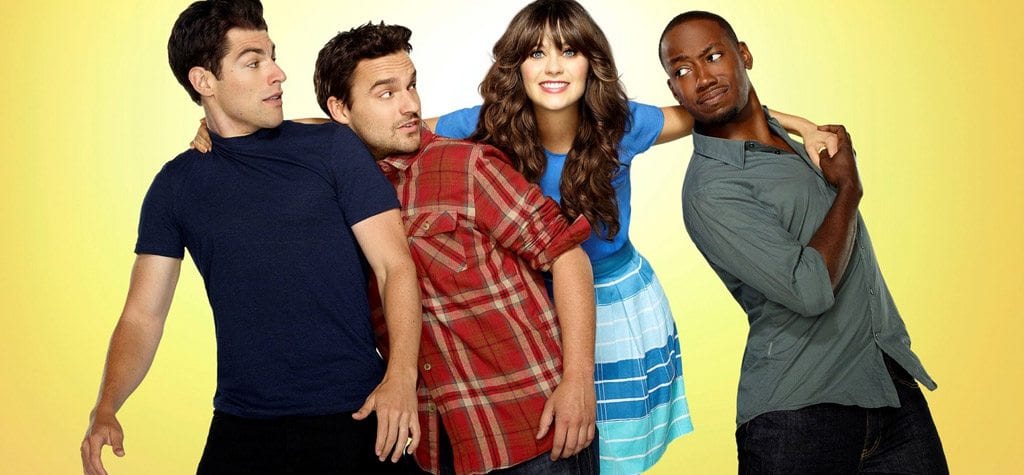
New Girl was created to showcase Zooey Deschanel’s skills
We don’t want to get all mean girl about New Girl’s main girl, but we’ve always been of the belief that Zooey Deschanel isn’t quite funny enough to lead a sitcom. For starters, her personal brand has always been extremely onenote, with a skill set that includes her bulging her eyes adorably at things, making cute noises, playing the ukulele when times get tough, and wearing adorkable dresses to grown up functions. None of which is something that we would have ever liked to see a sitcom built around.
Except from the sounds of it, that was exactly how New Girl was created. Speaking to Collider about the show, Deschanel divulged her enormous joy at realizing New Girl was basically all about her.
“Nothing is better than being on a TV show where you have all these great writers, writing for me every week, thinking about what I do best and writing that. There’s nothing more exciting for an actor than that . . . I love doing movies, but there’s something so nice about coming to work every day and knowing that this is something that is being created around you. That’s very exciting.”
New Girl tries too hard to be kooky
Speaking of which, we all know “kooky” is Deschanel’s personal brand, but her vibe also smothers the show to the point where it feels like a series of quirks, zany mishaps, and random fun times just slapped together with some glitter glue and unicorn spit.
For instance, the most recent episode of the series featured a classic New Girl scenario that we actually can’t believe hasn’t happened before on the show – a memorial service for a dead cat. This is a show that’s also thrown a bachelor party and sorts of other japes for the feline friend. Unlike those moments, the cat memorial isn’t just a single scene. The majority of the episode revolves around this kooky conceit.
The funeral for Winston’s (Lamorne Morris) cat Ferguson gave us a reasonably heartfelt glimpse of the character dealing with his own struggles and preparing for fatherhood (apparently you can only have a new baby or an old cat, but you can’t have both) but it still felt impossibly kooky.
Said funeral was also peak-New Girl, using a quirky plot device to delve into the deeper emotional depths of a key character. It also sounds like an idea that was pulled out of a big bag of “unused New Girl quirky plot points” that we can only assume is overflowing in the corner of the show’s writing room.
We aren’t saying that was definitely the case, but showrunner Dave Finkel (United States of Tara) did reveal to IndieWire that a “cat funeral” episode has been on the cards for a while now. “This idea for a Ferguson funeral piece, one of our writers, Noah Garfinkel, has been pitching this idea for a couple years now.
“We kept going like, ‘No, no, no, no, no. We can’t do that, we can’t do that.’ And then when we knew we were flashing-forward and we were on our writers’ retreat, he brought it up again. We were like, ‘Yep, now’s the time.’” Explains everything, to be honest. We have nothing further to add.
Jess (Deschanel) and Nick (Jake Johnson) are the worst will-they-won’t-they couple ever
Their relationship has been on and off for the duration of New Girl’s existence and honestly? Their romantic coupling is one of the worst on TV. Part of the problem is that the two were paired up far too early in the show’s run and the writers subsequently failed to develop them both as individuals outside of their relationship as and when they split up for upteenth time.
That made Jess into a cutesy caricature of a woman whose brash optimism (even in the face of heartbreak) made her insufferably twee and that turned Nick into an unlovable immature loser who continued to live with his ex-girlfriend for some stupid reason that is completely beyond us. As individuals, they’re awful and as a couple, they’re baffling. And yet the show has continued to pivot around this relationship for the entire stint of the show.
New Girl’s characters have all become Joey from Friends
By which we mean all of the characters have become unbearably rigid over time in a way that makes the show predictable, stiff, and resolutely static. As Uproxx once astutely reasoned, “They’re like Joey Tribbiani, a character that got a laugh one time because of his enthusiasm for sandwiches, and five seasons later, he was practically defined by his love of them.”
Now, don’t get us wrong – there’s a place in the world for the comforts of a TV show that sticks to the familiar and just churns out chuckles to the same formula week in and week out, but New Girl has passed that point. It’s no longer a familiar comfort to watch and is instead a series of recycled jokes the writers keep hoisting out of the proverbial quick sand of sitcom failures in the hopes it’ll see them through for another week.
New Girl made Max Greenfield unattractive
You monsters! This is perhaps the most unforgivable crime New Girl has committed. With the character of Schmidt they took a dreamboat like Greenfield and turned him into a ghastly one-dimensional stereotypical bro. We’ll tell you exactly the moment we officially checked out of New Girl – S4E7. An episode in which Schmidt puts earphones on his girlfriend Cece (Hannah Simone) so he can say goodbye to his two “best friends” – her beautiful tits – as she goes to get a breast reduction. It is horrendous.
There’s obviously something incredibly disconcerting about seeing a man reduce a woman to her “fun bags”, but we’re also insulted on behalf of straight men everywhere. We give you a hard time sometimes dudes, but you deserve way better than to be depicted as a batch of boob brained buffoons so emotionally immature you can’t function without the support of a bosom.
Being quirky with Zooey Deschanel: Why New Girl is still the absolute worst
Time has not been kind to New Girl, but the show was already doing most of the damage itself. What once passed for twee charm now reads as a prolonged exercise in creative stagnation, tonal confusion, and casual offensiveness. Rewatching the series in 2026 doesn’t reveal a misunderstood sitcom ahead of its time; it confirms a show deeply trapped in its own bad instincts, mistaking repetition for personality and quirks for substance.
The central problem remains the same: New Girl was engineered around Zooey Deschanel’s persona rather than around characters that could grow, clash, or evolve. Jess Day is not written as a person so much as a brand expression — wide-eyed whimsy, childlike enthusiasm, and emotional excess presented as inherently lovable. The show treats these traits as immune from critique. When Jess is disruptive, invasive, or selfish, the narrative bends to reassure the audience that her behavior is charming, not harmful. This framing isn’t just lazy; it’s sexist in its own way, reinforcing the idea that a woman’s immaturity is endearing as long as it’s cute enough.
That sexism extends outward. Female characters exist largely in relation to men and their desires. Cece, in particular, is persistently reduced to her body. Her intelligence is a recurring punchline, her ambitions secondary to her appearance, and her value frequently framed through male approval. The show tries to pass this off as self-aware irony, but the jokes land far too comfortably inside the stereotype to function as critique. When a storyline literally revolves around a man mourning his girlfriend’s breasts, the problem isn’t subtle.
The male characters fare no better, though in a different direction. New Girl has a habit of flattening men into caricatures, then congratulating itself for emotional depth when they cry once an episode. Schmidt becomes a walking embodiment of misogynistic excess — controlling, objectifying, and frequently cruel — while the show insists on redeeming him without meaningful consequence. Nick is infantilized to the point of dysfunction, his incompetence treated as a personality rather than a failure to mature. Winston, initially promising, is gradually sidelined into absurdity, his storylines increasingly detached from the emotional weight afforded to his white counterparts.
That imbalance feeds directly into the show’s racial problems. New Girl gestures toward diversity without ever committing to it. Winston is often the only Black character in the room, and the humor surrounding him leans heavily on awkwardness, exaggeration, and isolation. His emotional arcs are delayed, diluted, or played for surreal laughs rather than explored with the seriousness given to others. Cece’s Indian heritage is similarly underutilized, referenced mainly when convenient or exoticized for humor. The show wants credit for inclusion while avoiding the responsibility of depth.
Then there’s the strangeness — not the good kind. New Girl mistakes randomness for originality. Entire episodes hinge on gimmicks so thin they feel like rejected sketch ideas stretched to sitcom length. A cat funeral. An incomprehensible drinking game treated as mythic lore. Time jumps deployed as narrative shortcuts rather than storytelling tools. These choices don’t build character; they stall it. The writers repeatedly reach for “kooky” scenarios instead of letting consequences accumulate or relationships meaningfully change.
This leads to the show’s most glaring flaw: nothing sticks. Characters reset. Lessons vanish. Growth is implied, then undone for the sake of another recycled joke. Everyone eventually becomes a version of themselves defined by one exaggerated trait, endlessly repeated. What once looked like comfort television curdles into creative inertia, a loop of familiar beats with diminishing returns.
The result is a sitcom that feels increasingly uncomfortable to watch — not because it challenges the audience, but because it refuses to. New Girl wants to be charming without being accountable, progressive without being precise, and weird without being thoughtful. In hindsight, its biggest failure isn’t that it’s annoying or indulgent or overly cute. It’s that it confuses affection with absolution, and expects the audience to do the same.
New Girl premiered in 2011 as a bright, offbeat sitcom about Jess, an overly earnest schoolteacher who moves into a loft with three men after a breakup. It quickly built a loyal following, but time and distance have made its flaws harder to ignore. Rewatching the series now exposes a show riddled with dated sexism, shallow racial representation, and narrative choices that mistake eccentricity for substance.
 Sexism and gender representation
Despite positioning itself as progressive, New Girl frequently leans on tired sitcom dynamics that undercut its supposed modern sensibility. Jess is the protagonist, yet she is repeatedly framed as naïve, emotionally excessive, or fundamentally less capable than her male roommates. Her defining “quirkiness” is rarely treated as a valid personality trait; instead, it becomes a recurring problem the men around her must manage, correct, or tolerate. The underlying message is familiar: women can be different, but only up to the point where that difference inconveniences men.
Early seasons further entrench this imbalance. Jess’s storylines revolve heavily around romantic failure, emotional turbulence, and her desire for partnership, positioning male approval as the primary marker of her fulfillment. Even when the show gestures toward feminist self-awareness, it repeatedly falls back on narratives that define women through their relationships rather than their autonomy.
Other female characters fare no better. Cece, an Indian-American model, is often reduced to a combination of beauty, romantic availability, and perceived intellectual inferiority. Her professional ambitions and inner life are routinely sidelined in favor of jokes about her appearance or her role in male character arcs, reinforcing stereotypes rather than challenging them.
Racism and stereotypes
While New Girl includes characters of color, its approach to diversity is largely cosmetic. Winston, the lone Black roommate, and Cece are present, but their characterization often lacks the depth afforded to their white counterparts. Racial identity is frequently mined for humor through offhand comments, awkward jokes, and exaggerated traits that blur the line between satire and reinforcement.
At times, the show appears to acknowledge racial bias, particularly when characters reveal their own ignorance. However, these moments are inconsistent and often undercut by jokes that land squarely on stereotype rather than critique. Without clear framing, it becomes difficult to tell whether the show is interrogating prejudice or simply repackaging it as comedy.
Winston, in particular, suffers from this ambiguity. His emotional development is delayed, fragmented, or played for absurdity, leaving him marginalized within the ensemble. The result is a familiar sitcom pattern where a Black character exists on the periphery, present for humor but rarely granted sustained narrative importance.
Strange structural choices and humor
Beyond representation issues, New Girl struggles with tone and structure. The show relies heavily on exaggerated “kooky” premises that often feel disconnected from character growth or narrative stakes. Entire episodes hinge on gimmicks so random they resemble unused ideas pulled from a grab bag rather than organic storytelling choices. A prolonged cat funeral is emblematic of this tendency: emotional beats are buried under layers of forced whimsy.
The recurring “True American” game follows a similar logic. Its appeal lies in its chaos, but the lack of internal logic or narrative purpose turns it into noise rather than world-building. These moments prioritize quirk for its own sake, stalling momentum instead of deepening relationships.
Character inconsistency compounds the problem. Schmidt evolves into a figure whose humor depends heavily on misogyny and insensitivity, yet the show frequently treats these traits as lovable flaws rather than behaviors with consequences. Growth is suggested, then undone, preserving the joke at the expense of accountability.
Bechdel and beyond
Even with a female lead, New Girl struggles to meet basic measures of gender balance. Early seasons barely manage to feature women interacting about topics unrelated to men, underscoring how deeply the show relies on heterosexual romance as its narrative engine. Attempts to foreground a female perspective are repeatedly undermined by this structural dependency.
Intent versus impact
There is a recurring defense that New Girl is self-aware, that its stereotypes are exaggerated to expose their absurdity. In theory, the show aims to critique ignorance, sexism, and bias by embodying them. In practice, repetition dulls that intent. Over time, satire without sufficient distance begins to look indistinguishable from endorsement.
Viewed years later, many jokes read less like commentary and more like artifacts of a cultural moment that went unquestioned. The gap between what the show seems to want to say and what it actually communicates is why New Girl remains such a contentious rewatch: its intentions may have been playful or progressive, but its impact often tells a different story.






 Racism and stereotypes
 Strange structural choices and humor
 Bechdel and beyond
 Intent versus impact