Exploring the Best Casino Scenes in Film: From James Bond to The Hangover
Casinos have always been a favourite setting for Hollywood films. With their glitz, glamour, and high-stakes drama, they provide the perfect backdrop for intense and thrilling scenes. Over the years, many great films have been made that feature memorable casino scenes. Also, films are part of many games found on the best online casino sites.
The connection between the film and casino industries runs deeper than shared spectacle. Production teams routinely draw on real-world procedures, consultants, and locations to sell the illusion of risk, and audiences have come to expect a certain level of procedural honesty even when the story turns outlandish. This guide revisits five enduring casino sequences and adds four more recent landmarks that continue to shape how filmmakers stage gambling on screen.
Casino Royale (2006)
The 21st James Bond film places Daniel Craig’s 007 across the felt from Mads Mikkelsen’s Le Chiffre in Montenegro. Tom Sambrook served as on-set poker consultant, shaping the betting rhythms and table talk. The production chose dramatic hands that read clearly for a general audience rather than pure professional subtlety, yet the tension still registers because the mechanics feel grounded. Craig’s controlled physicality and the deliberate pacing of each raise keep viewers leaning forward even when the cards themselves are cinematic inventions.
Ocean's Eleven (2001)
Steven Soderbergh’s remake stages its centerpiece heist inside the real Bellagio. The casino granted the crew access to its security control room, allowing cameras to capture authentic footage of the vault corridors and surveillance arrays. That cooperation lets the sequence linger on practical details—keycard readers, time-coded monitors, the precise choreography of guards changing shifts—without resorting to exposition. David Holmes’s score threads through the editing, turning procedural steps into a percussive countdown that still plays like clockwork fifteen years later.
Rain Man (1988)
Barry Levinson’s film sends Tom Cruise’s Charlie Babbitt and Dustin Hoffman’s Raymond to Las Vegas so Raymond can count cards at the blackjack tables. The production filmed inside actual casino floors, and the dealers’ procedural language matches industry practice. The famous confrontation with the pit boss, played by James Hong, crystallizes the film’s central tension: Charlie’s desire for quick money versus Raymond’s need for order. The scene works because the mechanics of the game feel ordinary until Hoffman’s precise counting turns the ordinary into something quietly extraordinary.
Rounders (1998)
John Dahl’s poker drama pits Matt Damon’s Mike McDermott against John Malkovich’s Teddy KGB in a late-night New York hold’em session. Experts continue to single out the hand choreography for its fidelity to underground card-room etiquette. The film’s release coincided with the early internet poker boom; many viewers later credited its realistic depiction of tells, bankroll management, and table psychology with popularizing Texas Hold’em beyond niche circles. Malkovich’s chewing-gum mannerisms remain a shorthand for menace at the felt.
The Hangover (2009)
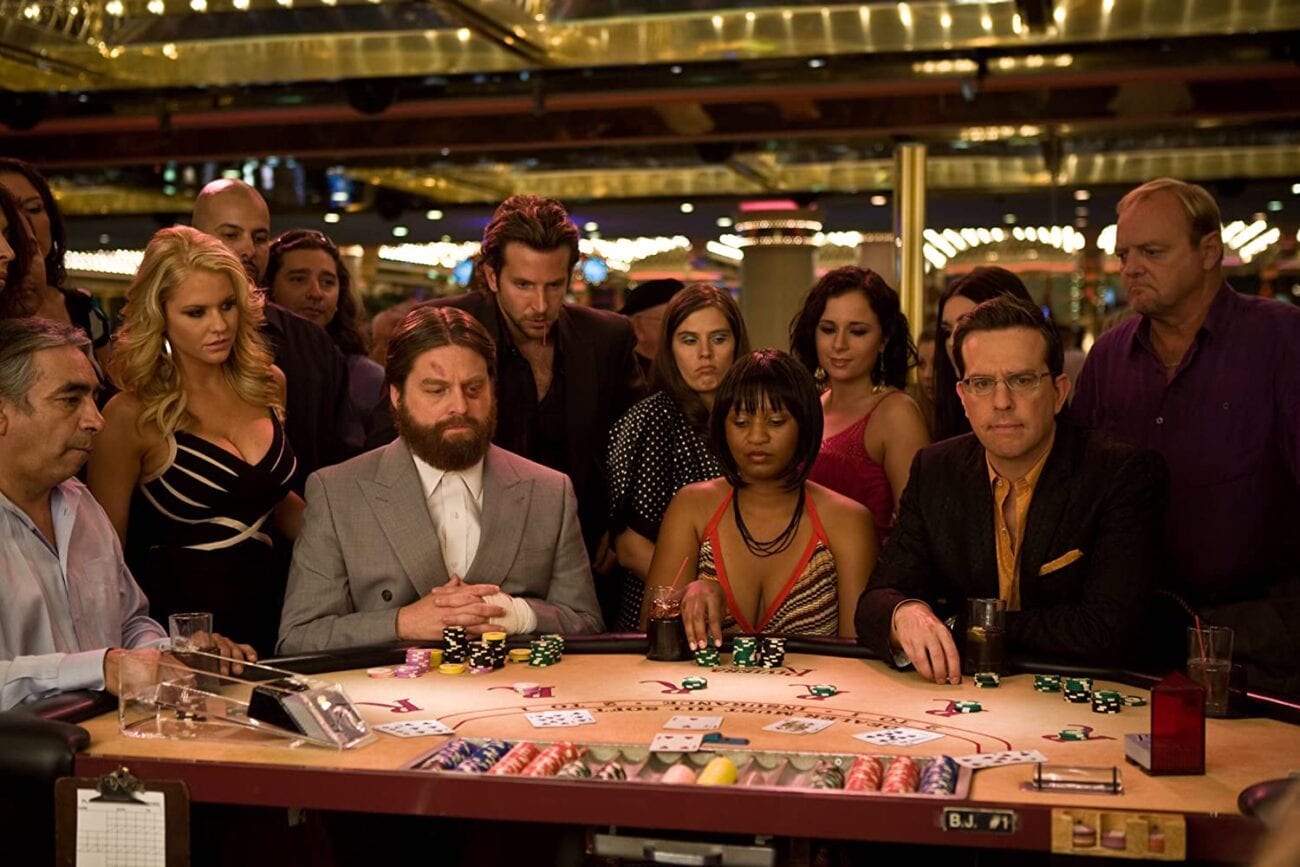
Todd Phillips’s comedy stages its celebratory blackjack run inside Caesars Palace. Mike Tyson later confirmed he was under the influence during the filming of the casino sequences and said the disorienting experience contributed to his decision to pursue sobriety. The cameo performance of “In the Air Tonight” therefore carries an extra layer of lived-in chaos that matches the characters’ own blackout state. The scene succeeds because the actors’ improvisations feel spontaneous even when the plot mechanics are tightly scripted.
Casino (1995)
Martin Scorsese’s epic follows Robert De Niro’s Ace Rothstein as he oversees the Tangiers casino during the mob-controlled 1970s. The production recreated real Las Vegas counting rooms and junket operations down to the ledgers and skim percentages. Sharon Stone’s Ginger remains a benchmark performance; recent 30th-anniversary retrospectives continue to cite her unraveling as one of the most precise portraits of how casino life consumes personal relationships. The film’s floor-level camera work still supplies the tactile grammar for later gambling dramas.
21 (2008)
Robert Luketic’s adaptation of Ben Mezrich’s book follows an MIT blackjack team that treats card counting as a disciplined group enterprise. The Las Vegas sequences were shot on location at the Hard Rock and Planet Hollywood, and the production worked with actual advantage players to calibrate the signals and betting spreads. While dramatized, the film’s team dynamic extends the solitary counting seen in Rain Man into a modern ensemble sport, and it still appears on 2025 “best gambling movies” lists for that structural shift.
Molly's Game (2017)
Aaron Sorkin’s screenplay draws directly from Molly Bloom’s memoir of running high-stakes private poker games for celebrities and billionaires. Jessica Chastain’s Bloom presides over rooms where seven-figure pots change hands without ever touching a public casino floor. The film’s poker scenes emphasize the social choreography—seating arrangements, drink orders, the quiet negotiation of ego—rather than the cards themselves. Its inclusion on recent “best gambling movies” roundups reflects how underground games now sit alongside traditional casino settings in the genre’s expanding map.
The Card Counter (2021)
Paul Schrader’s lean drama centers on Oscar Isaac’s William Tell, a professional gambler who treats card counting as both livelihood and penance. Shot largely in real casino environments, the film keeps the tables dimly lit and the wins modest, offering a darker counterpoint to heist comedies and ensemble capers. Tell’s nightly routines—logbooks, disciplined bet sizing, solitary hotel rooms—mirror the procedural honesty that earlier films established while stripping away glamour. The picture continues to surface in 2025-2026 recommendations for viewers seeking a somber meditation on gambling’s long tail.
Together these sequences demonstrate how casino settings adapt across genres and decades without losing their core appeal: the visible arithmetic of risk, the choreography of surveillance, and the human impulse to test fortune under bright lights. Whether the table is in Montenegro, the Bellagio vault, or an anonymous underground room, the best scenes keep the mechanics legible and the stakes personal.