Has gay Tumblr uncovered Martin Scorsese’s secret movie ‘Goncharov’?
Gay Tumblr has always thrived on collective invention, and the Goncharov phenomenon stands as one of its sharpest displays. What began as a throwaway label on a pair of knockoff boots evolved into an elaborate shared fiction about a 1973 Martin Scorsese mafia epic that never existed. The joke landed because the platform already spoke that language fluently: borrowing characters, building lore on the fly, and treating sincerity and irony as the same currency.
Made man
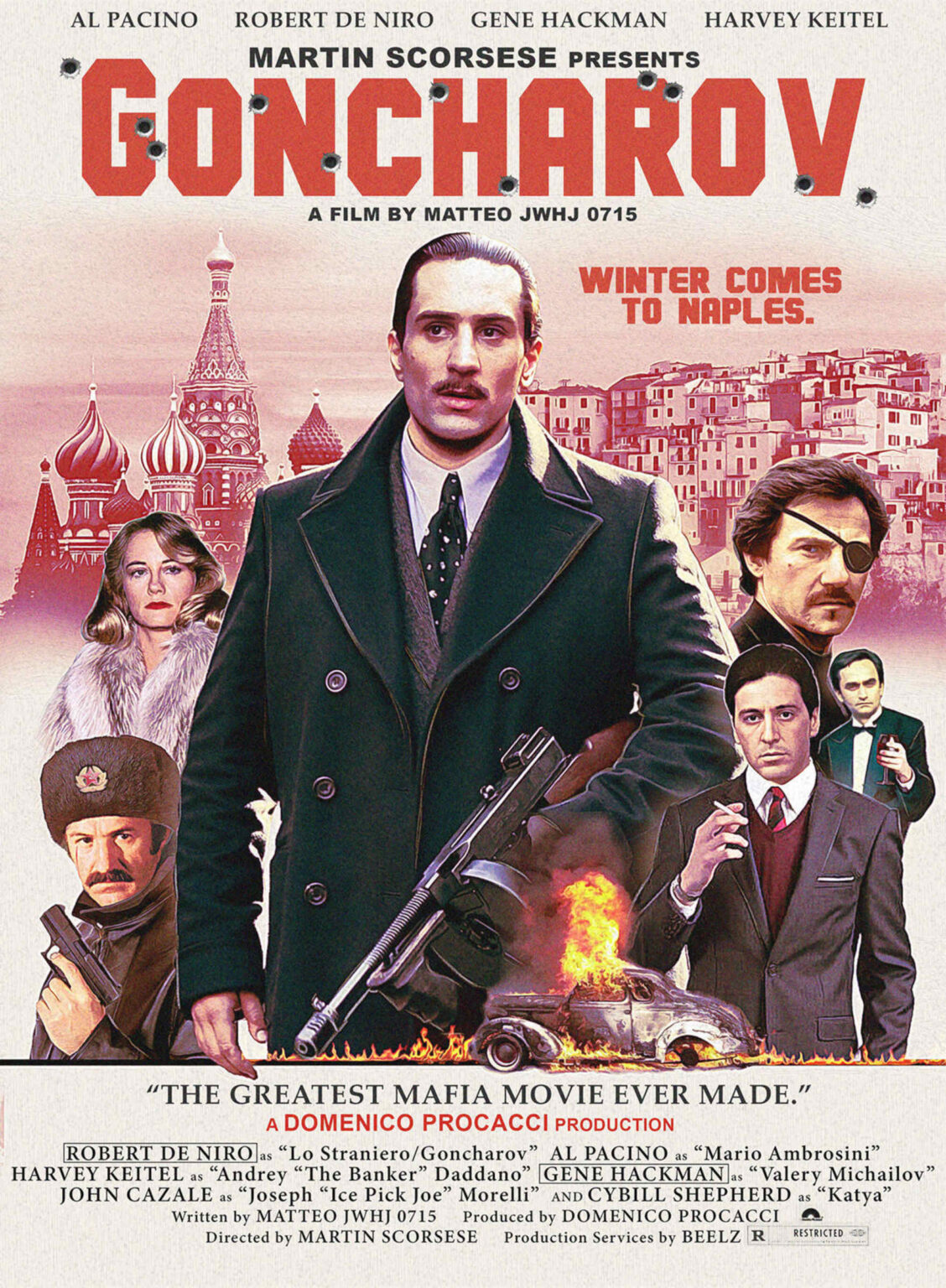
In 1973, Martin Scorsese was thirty-one with two features behind him and a growing interest in stories about organized crime. The film that supposedly followed, Goncharov, never reached production. Its existence rests entirely on a 2020 Tumblr post by zootycoon that showed the inside of a boot stamped with the phrase “The greatest mafia movie ever made. Martin Scorsese presents GONCHAROV.” Years later the image resurfaced, a fan-made poster appeared, and the hellsite treated the label as canon. From there the nonexistent film acquired a cast, a plot, and a visual identity that felt authentic enough to fool casual scrollers.
It’s deep!
Gay Tumblr’s comfort with fanfiction made the expansion feel natural. Users filled in a story of betrayal, loyalty, and homoerotic tension between characters named Goncharov, Andrey, and Katya. Over five hundred works appeared on AO3 within weeks. A collaborative Google Doc tracked continuity. An itch.io game jam produced more than seventy entries. The output moved past parody into something closer to distributed world-building, complete with the same tonal shifts and moral gray areas that define prestige crime dramas.
Wild ride
Once the meme crossed to Twitter, coverage followed from outlets including The New York Times, Forbes, and Polygon. Martin Scorsese’s daughter posted a TikTok in which the director acknowledged the nonexistent film with a knowing smile. The moment confirmed that the prank had reached its subject without breaking the shared fiction. International outlets picked up the story, and Tumblr briefly became the top-trending topic across platforms that usually ignore it.
The beginning
The spark remained that single image of boots. The label’s confident phrasing invited anyone scrolling past to treat it as evidence rather than marketing copy. No additional context was needed; the post supplied its own authority.
Fanmade
Within days a detailed poster appeared, complete with period-appropriate typography and a fake production company. Other users contributed lobby cards, soundtrack cues, and even a fake Letterboxd page before the platform removed it. The visuals gave the fiction enough weight that casual viewers could mistake it for an overlooked Scorsese title.
To the birds
Once Twitter amplified the posters and plot summaries, the conversation spread beyond niche circles. People who had never used Tumblr encountered the same characters and asked the same questions about a film that did not exist. The speed of the spread highlighted how little gatekeeping remained once an inside joke acquired shareable images.
Scorsese's Response
Scorsese’s indirect nod arrived through his daughter’s TikTok in late 2022. The clip showed him reacting to the meme with amused recognition rather than confusion or dismissal. The gesture kept the tone light while signaling that the director understood the affection behind the fabrication.
Academic and Scholarly Interest
By 2024 and 2025, researchers began treating Goncharov as a case study. Papers examined how distributed online authorship constructs narrative without a single authority and how existing copyright frameworks struggle to account for collective, noncommercial creation. The meme supplied concrete examples of fan labor that produced measurable cultural output without traditional ownership structures.
Interactive and Multimedia Extensions
Beyond text and posters, participants produced collaborative theme music involving at least thirty contributors. The itch.io game jam yielded dozens of playable entries. Character quizzes on uQuiz continued to circulate, letting new users align themselves with Katya, Andrey, or Goncharov long after the initial spike. These extensions turned the fiction into a persistent sandbox rather than a one-off gag.
Legacy and Longevity
Three years after the poster went viral, Tumblr tags still host anniversary posts. Reddit threads and TikTok videos reference the same characters. Fan wikis maintain cast lists and plot summaries. The activity has narrowed to dedicated niches, yet the fiction remains legible to anyone who encounters the original boot image or a surviving poster. Academic citations and recurring quizzes suggest the meme functions less as a fleeting trend and more as a durable shorthand for collective creativity online.
For the ages
Gay Tumblr turned a misprinted label into a shared cultural object that outlasted its 2022 peak. The episode demonstrated how quickly a platform built on text and image can generate narrative density when the premise is absurd enough to invite participation. Years later the same characters and conflicts continue to circulate in smaller but steady volumes, proof that the hellsite can still manufacture its own canon when the mood strikes.