



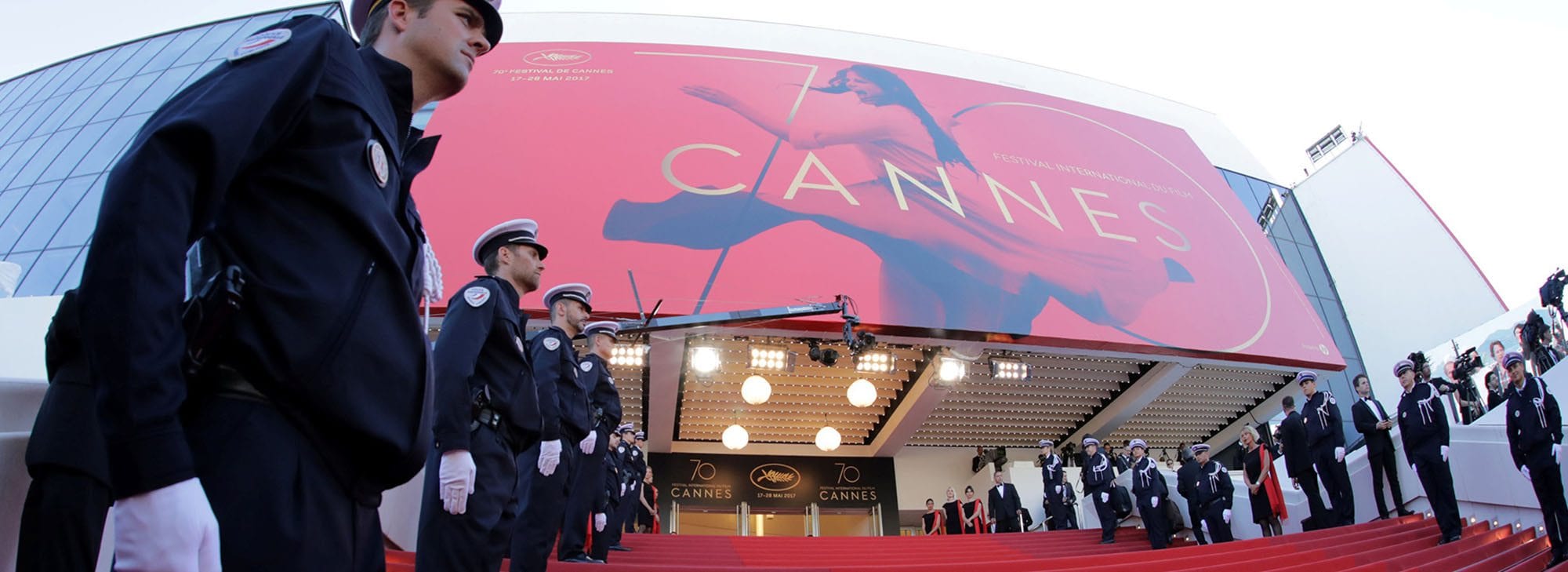
Everything that could possibly offend you about this year’s Cannes Film Festival poster
Time to get those “offended” caps off the shelf, folks, because the official 2018 Cannes Film Festival poster is out and no doubt it’s about to cause an uproar of Biblical proportions. But before we dive in, first let’s turn our attention to last year’s “scandal”, involving Claudia Cardinale, her thin thighs, and (shock, horror) a hint of airbrushing. Yes, despite the fact most movie covers and fashion industry photoshoots are airbrushed within an inch of their lives, social media was “up in arms” about the Cannes 2017 poster over accusations the archive image of Claudia Cardinale (The Pink Panther) had been retouched to make her thighs a little thinner. Leading French publication Le Monde asked, “[I]s Claudia Cardinale not perfect enough? Apparently not . . . She has become skinny and even her feet have shrunk.” Not the feet! Newspaper Liberation chimed in with, “Claudia Cardinale dropped a dress size in one swirl.” Elsewhere, tweeters picked apart the poster like they were on the brink of unfurling an illuminati conspiracy. A touch of airbrushing? On a heavily Photoshopped and edited image? What an unfathomable expression of sexism and misogyny*. It’s no surprise people were so offended. Well, aside from Cardinale herself who wasn’t bothered at all and said it was an “honor” to be included in the Canne’s 70th edition poster. But you know, aside from her, everyone was pissed.
2017 Claudia Cardinale Poster Recap
The 2017 controversy centered on an archive shot of Claudia Cardinale that festival organizers lightly retouched. Cardinale herself dismissed the row as a false row and described the selection as an honor. The episode set a template for how quickly a single poster could generate headlines about representation and retouching long before the next edition arrived.
2018 Poster Design Details
The 2018 poster came from graphic designer Flore Maquin. It used a Georges Pierre photograph from Jean-Luc Godard’s Pierrot le Fou (1965) showing Jean-Paul Belmondo (A Woman Is a Woman) and Anna Karina (Alphaville) in a kiss. The image leaned on the film’s pop-culture energy rather than a new shoot, a choice that kept the poster firmly in the festival’s tradition of repurposing classic frames.
#MeToo Timing and Representation Commentary
The poster landed as the #MeToo movement reached its peak in 2018. That spring, 82 women including Cate Blanchett marched the red carpet steps to spotlight the fact that only 82 female directors had been selected since 1946 compared with 1,688 male directors. The protest turned the festival into a visible site of industry reckoning without altering the schedule or the choice of poster art.
Poster Design Evolution Since 2018
Poster choices have shifted in tone since the 2018 Godard image. Hartland Villa designed the 2025 double poster tribute to A Man and a Woman and returned for the 2026 edition featuring Geena Davis and Susan Sarandon from Thelma and Louise. Earlier Godard references appeared in 2016 with a Contempt still, so the 2018 Pierrot le Fou selection sat inside a short run of French New Wave nods rather than standing alone.
Impact of the 2018 Gender Protest
The 82-woman protest during the 2018 festival highlighted the Palme d’Or record at the time: only two women had won the top prize in the festival’s history. The action stayed focused on selection data and board composition rather than any single image, yet it framed every visual choice that year, including the poster, as part of a larger conversation about access.
Current Cannes Gender Parity Measures
Cannes signed a gender parity charter in 2018 that required equal numbers on decision-making bodies and annual publication of selection statistics. Recent reports show permanent staff at 54 percent women. In 2025 four women chaired major juries, including Juliette Binoche. These steps address some of the structural points raised during the 2018 protest, though female directors remain a small share of main competition slots each year.
Godard and Pierrot le Fou in Festival History
Godard’s work has surfaced on Cannes posters twice in recent decades: Contempt in 2016 and Pierrot le Fou in 2018. Both used archival stills rather than new photography. The 2018 image drew from the 1965 film’s Georges Pierre shot of Belmondo and Karina, a frame already familiar to cinephiles and therefore less likely to read as a fresh provocation once the initial round of commentary passed.
The rage might’ve died down, but it’s about to bubble up again thanks to the release of the 71st Festival de Cannes poster, inspired by the work of Georges Pierre and taken from Jean-Luc Godard’s Pierrot le Fou, in which an unhappily married man who is fired from his job decides to run away with an ex-girlfriend as she is chased down by hitmen. The poster itself is the work of graphic designer Flore Maquin, who used pop culture as her influence. Nothing wrong so far, right? Wrong! If people can find fault in a smidge of airbrushing, they’ll find fault in an image crafted by Godard showing Jean-Paul Belmondo (A Woman Is a Woman) and Anna Karina (Alphaville) making out. Now’s time to put on that “offended” cap, because we’re about to look at the poster through the neggy-hued glasses of a grade A virtue-signaller. First up is the choice of Godard. Godard is a man. A man with a peen. Therefore the image is drawn out from the male gaze. How are we supposed to reach gender parity in the filmmaking business when men are behind the camera? Only the choice of a female director’s work could’ve fixed this mess. Okay, so the women in Godard’s films were liberated and independent. And yes, they were never stock characters and had strong and worthy roles. Alright, and Karina’s character was kinda complex and headstrong. But . . . erm . . . where were we going with this again? Ah yes, the power struggle. Just look at the way Karina recoils in disgust as Belmondo forces her into that kiss. It’s clear from the body language she’s being dominated in the same way women are dominated in a patriarchal society. Why Cannes chose such an image in the wake of the #MeToo movement is beyond us. Then there are the outfits. Belmondo’s in a full suit, while Karina’s just in a tee. Erm, hello? Is this not a major representation of the societal pressures on women today, presenting the female character in a sexual manner while the man is free to cover up? Only a male director could create such an image – come on Tweeters, do your worst. And now, why we’re all here – Cannes clearly hasn’t learned from its mistakes from last year. That airbrushing technique is on fleek. In other words, it’s been retouched (no doubt by a man’s instructions) in an insulting and unnecessary way to facilitate the idea that women are worthless unless they’ve been edited. If the film industry ever wants to move forward in the fight for equality, the only logical next steps would be to ban airbrushing, ban male directors, and ban movies that represent the male gaze. Will we ever get there? Maybe one day. But until then, let’s stand together in solidarity and hold a red carpet black dress protest against the Cannes poster and everything it represents. See you in Versace, bitches. *Editor’s note: Film Daily cannot be held accountable for the terrifying levels of sarcasm presented by its staff writers.
