Famous landmarks destroyed by movie monsters
Hollywood has always loved a spectacle, and nothing lands quite like the sight of a beloved skyline reduced to rubble on the big screen. From the earliest days of stunt work to today’s seamless CGI, the appetite for landmark destruction has only grown. The famous train wreck in Buster Keaton’s The General set an early benchmark, but the scale has since expanded from bridges and trains to entire cityscapes and monuments that audiences recognize instantly. These scenes often double as marketing hooks, pulling crowds in with the promise of something they normally only imagine in their worst-case daydreams.
Visual effects have reached a point where the impossible looks real enough to prompt genuine gasps. When the real Notre Dame caught fire, the world watched with collective grief; when the same structures fall on screen, the reaction is closer to awe. That contrast is precisely why directors keep returning to the trope. The destruction feels safe to watch because it is staged, yet the familiarity of the landmarks makes every collapse register immediately.
Vibrant Doors tapped into that fascination with a series of retro travel posters that reimagine the moment each monument meets its cinematic end. The posters freeze the chaos in vintage style, pairing the ruined landmark with the monster or force responsible. The collection captures both classic and newer entries in the genre, keeping the focus on the landmarks themselves.
Terminator: Salvation (2009): The Hollywood Sign
The fourth Terminator film places the familiar hillside letters squarely in the path of Skynet’s machines. The sequence costs far less on screen than the reported $200 million budget, yet the image of the sign under fire has become shorthand for Los Angeles in peril. The landmark has been damaged or destroyed in multiple films since, including Independence Day, San Andreas, and The Day After Tomorrow, turning the sign into a reliable visual cue for California-wide catastrophe.
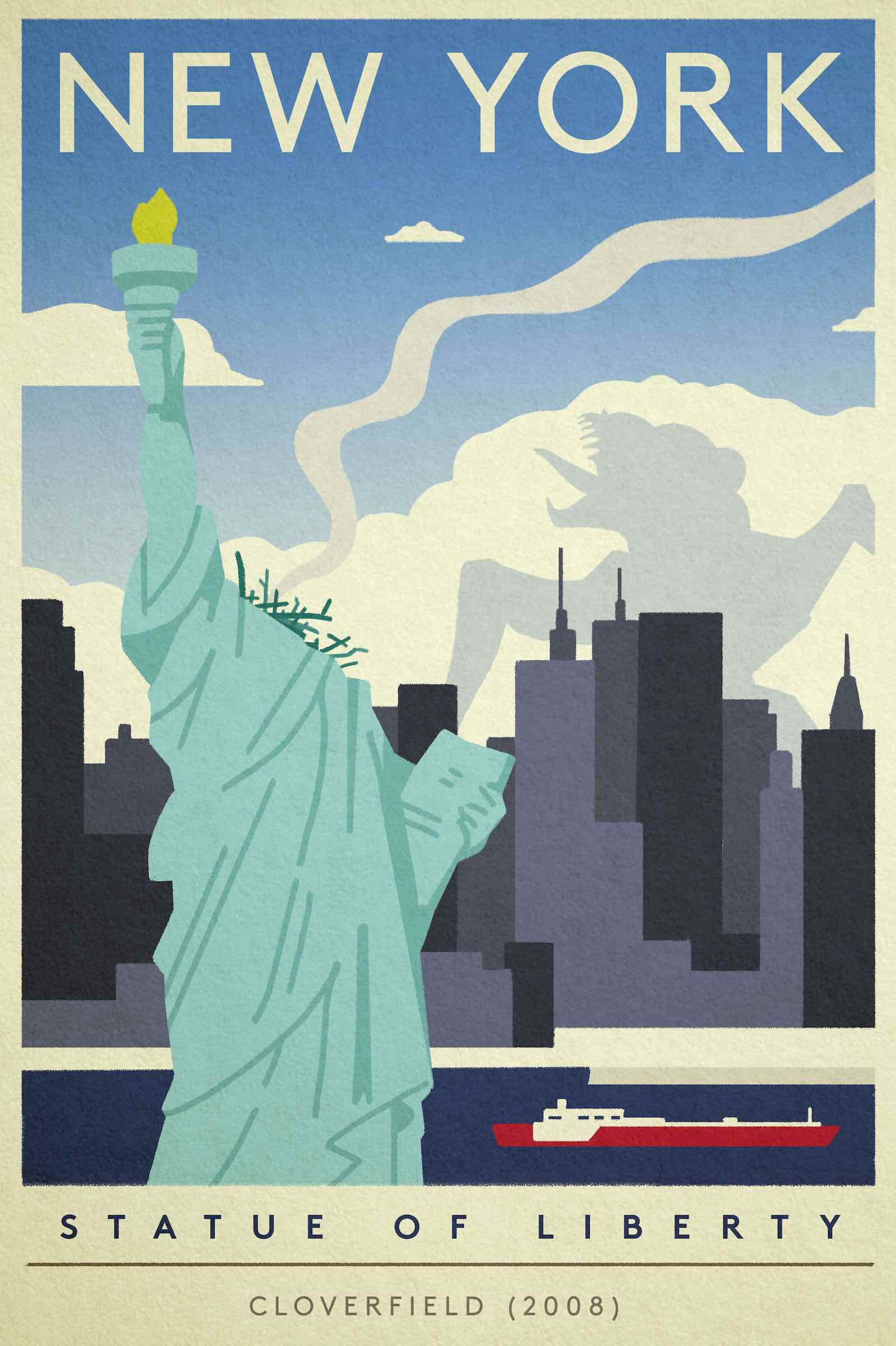
Cloverfield (2008): Statue of Liberty
Matt Reeves’s found-footage approach made the decapitated head of the Statue of Liberty rolling down a Manhattan street one of the film’s most memorable images. The shot appeared in nearly every trailer and poster, giving audiences an immediate sense of scale before the creature even appeared fully on screen. The image remains one of the franchise’s strongest marketing moments.
Pacific Rim (2013): Golden Gate Bridge
Guillermo del Toro opens his kaiju epic with a direct hit on the Golden Gate Bridge, establishing the threat before the human pilots even suit up. The sequel, Pacific Rim Uprising, arrived in 2018. No third theatrical film has followed, though a comic series titled Pacific Rim: Final Breach is scheduled for May 2026. The $1.5 billion figure once cited as a rebuild cost remains illustrative; related retrofit projects have reached $1.8 billion phases in recent years.
The Birds (1963): Potter Schoolhouse
Alfred Hitchcock turned the modest schoolhouse in Bodega Bay into an icon of dread. The building itself was never a tourist draw until the film placed it at the center of the avian siege. The structure still stands, and visitors who know the movie often stop to photograph the same angles used in the attack sequence.
Harry Potter & The Half Blood Prince (2009): The Millennium Bridge
The bridge had opened only nine years earlier when the Death Eaters brought it down in a single sequence. The visual effects team spent months on the collapse, and the shot featured prominently in trailers. The scene underscored how far the franchise had come in blending practical sets with digital destruction.
Mars Attacks (1996): The Taj Mahal
Tim Burton’s alien satire levels several global icons, but the Taj Mahal sequence stands out for its casual cruelty. The Martians pose for a snapshot as the mausoleum crumbles behind them, turning an act of mass destruction into a tourist photo op. The same film also topples Mount Rushmore and the Houses of Parliament, spreading the damage across continents.
Godzilla x Kong: The New Empire (2024): Great Pyramids of Giza
The latest MonsterVerse entry brings the fight to ancient Egypt. During a clash between Godzilla and Kong, the Great Pyramids of Giza take direct damage. The sequence also shows the Victor Emmanuel II Monument in Rome and parts of the Colosseum under threat, extending the kaiju-scale destruction to some of the world’s oldest surviving structures.
Godzilla: King of the Monsters (2019): Washington D.C. Landmarks
King Ghidorah’s storm system batters the Capitol Building while the monster trio battles across the city. Later, the final confrontation shifts to Boston and levels Fenway Park. The film uses recognizable American landmarks to ground the spectacle in places audiences already know from news footage and travel photos.
Independence Day: Resurgence (2016): Global Landmarks
The sequel expands the alien invasion beyond the first film’s American targets. City Destroyers level the Burj Khalifa, Tower Bridge, and multiple sites across Singapore. The international scope keeps the destruction moving from one recognizable skyline to the next, reinforcing the scale of the threat.
The Recurring Hollywood Sign Trope
Beyond its appearance in Terminator: Salvation, the Hollywood Sign has been toppled or damaged in at least five other major releases. Filmmakers return to it because the letters function as instant visual shorthand for Los Angeles or, more broadly, for California itself. Each new destruction plays on the same cultural recognition that makes the original sign a tourist landmark in real life.
The posters from Vibrant Doors capture these moments in a style that feels both nostalgic and slightly macabre. They turn the destruction into collectible art while reminding viewers how often cinema returns to the same monuments for its biggest set pieces. The landmarks remain standing in reality, yet on screen they continue to fall, one blockbuster at a time.