




Leah Remini’s nude truth: How bad was her experience in Scientology?
Hold on to your e-magazine reading glasses because we’re about to dive deep into the intriguing world of Leah Remini! In this captivating article, we uncover the naked truth behind her experience in Scientology. From jaw-dropping revelations to eyebrow-raising anecdotes, we leave no stone unturned as we peel back the layers of secrecy. Do you think you can handle scient ology’s nude truth?
Lights, camera, controversy! Leah Remini’s journey from beloved TV star to Scientology scandal sensation is a tale that could give any soap opera a run for its money. Picture this: a feisty and fearless actress capturing our hearts on the small screen, only to find herself tangled in a web of secrecy, strange rituals, and the infamous Scientology organization. Cue the dramatic music!
Leah Remini, with her razor-sharp wit and undeniable talent, skyrocketed to fame, becoming a household name in the blink of an eye. But as we all know, fame comes with its fair share of surprises. Little did she know that her association with Scientology would become the plot twist of a lifetime. It’s like an episode of her own reality show, but with less wine-throwing and more mystery.
From TV Stardom to Scientology Scandal
We’ll dig deep into the scandalous world of Scientology, exposing the bizarre rituals, the relentless pursuit of control, and the strange allure that drew Leah Remini in. Get ready to buckle up, folks, because this ride is about to take us from TV stardom to a scandalous saga that will leave you saying, “What the Xenu?”Grab your tin foil hats, because we’re definitely about to embark on a shadowy journey.
Leah Remini, with her quick wit and no-nonsense attitude, found herself immersed in a world where rules are as flexible as a rubber band. In Scientology, secrets are guarded tighter than Tom Cruise’s stunt double. From strange rituals to the infamous “Bridge to Total Freedom,” she took us on a wild ride through the halls of the Church of Scientology.
In this snark-filled exposé, we’ll dig deep into Leah Remini’s firsthand experiences within the secretive organization. Get ready for eyebrow-raising anecdotes, mind-boggling rituals, and a glimpse into the curious mind of a woman who dared to question the status quo. Leah made a daring escape from the clutches of the secretive organization, leaving us all wondering, “What the Thetan just happened?”

The Naked Truth: Leah Remini’s Bold Departure:
With a sassy flick of her metaphorical ponytail, Leah Remini turned her back on the dogma, the audits, and the relentless pursuit of spiritual enlightenment. But this was no ordinary exit. Oh no, dear readers, this was a bold departure worthy of its own Hollywood blockbuster. It was like watching a high-stakes game of Scientology bingo, and Leah shouted, “Bingo!” as she walked out the door.
From legal battles to fierce public confrontations, she fearlessly exposed the underbelly of Scientology, revealing a world of control, manipulation, and a thirst for power that would make even the most seasoned reality TV villain blush. So grab your E-meter-shaped popcorn, sit back, and prepare to witness the naked truth of Leah Remini’s journey toward freedom. It’s a wild ride you won’t want to miss!
Leah Remini’s journey from TV star to an outspoken critic of Scientology is a rollercoaster ride that leaves us both entertained and enlightened. As we bid farewell to this cheeky exposé, we’re left with a newfound understanding of the challenges Leah Remini faced within the confines of the secretive organization. Her bold departure and subsequent revelations have hopefully sparked a conversation.


Leah Remini’s nude truth: How was her experience in Scientology?
Leah Remini spent more than three decades inside the Church of Scientology, entering as a child and leaving as a public figure willing to describe what life inside actually looked like. Her account—laid bare through interviews, testimony, and her documentary work—offers one of the most detailed insider perspectives ever shared by a high-profile former member.
Remini was introduced to Scientology at a young age, when her family joined the organization in the mid-1970s. From the outset, Scientology was not presented as a belief system but as a total way of life. Education, friendships, ethics, and ambition were filtered through church doctrine. As a child, Remini learned that loyalty to the organization came before all else, including family relationships and personal boundaries.
Discipline and hierarchy defined daily existence. Members were expected to comply without question, and dissent—even curiosity—was framed as moral failure. According to Remini, criticism was not treated as disagreement but as evidence of personal corruption requiring correction. This framework discouraged independent thought while reinforcing dependence on the institution for validation and advancement.
As Remini’s acting career grew, her visibility brought both privilege and pressure. Celebrity members are often treated differently within Scientology, but Remini has stated that status did not shield her from control. Instead, it intensified expectations. High-profile members were seen as representatives of the church, expected to model obedience and silence. Public success became another asset for the organization to leverage.
One of the most central practices Remini has described is auditing, Scientology’s core counseling ritual. Framed as spiritual therapy, auditing involves revealing deeply personal memories and experiences. Remini later characterized the process as invasive, arguing that it blurred boundaries between spiritual guidance and psychological surveillance. She has said that information shared during auditing could later be used as leverage, reinforcing conformity.
Disconnection was another defining aspect of her experience. Scientology policy allows—and in some cases mandates—members to sever ties with people deemed “suppressive,” including family and friends. Remini has spoken about how this policy weaponized relationships, turning love into a conditional privilege. The threat of losing one’s entire social world kept many members compliant, even when doubts arose.
The breaking point for Remini came not from a single incident but from accumulated contradictions. She has described moments where basic questions were met with hostility rather than answers. When she began asking why leadership figures were treated as untouchable, and why transparency was discouraged, she found herself increasingly isolated within the organization. Curiosity itself became evidence of disloyalty.
Leaving Scientology was not portrayed by Remini as an instant liberation, but as a slow, disorienting process. After decades of being told how to think, what to fear, and whom to trust, exiting meant reconstructing identity from scratch. She has been candid about the emotional aftermath: guilt, anxiety, and the difficulty of rebuilding relationships severed by church policy.
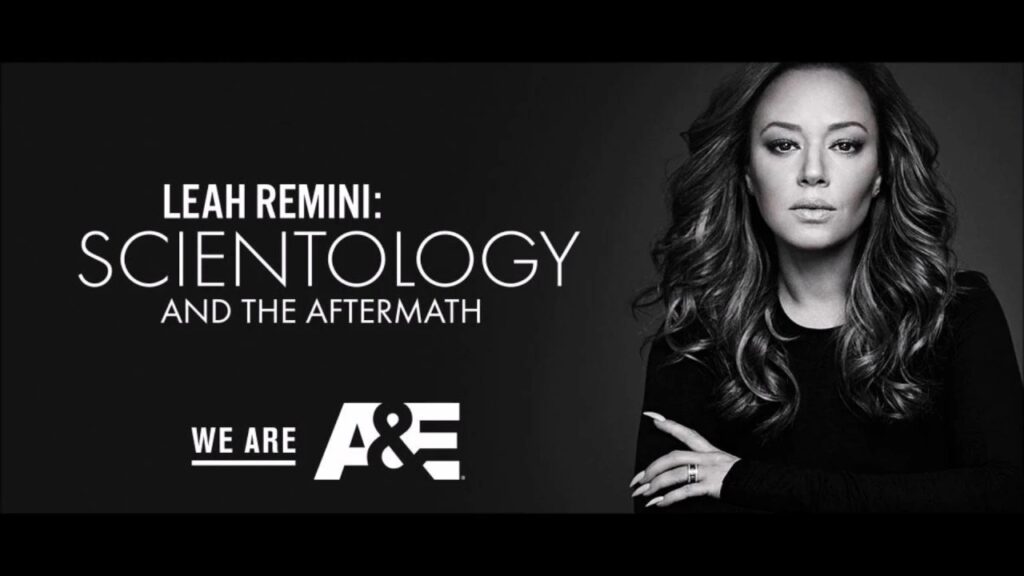
Remini’s most significant public reckoning came through Leah Remini: Scientology and the Aftermath, where she provided a platform for former members to share their stories. The series reframed her experience from personal grievance to systemic critique. By centering multiple voices, Remini demonstrated that her story was not an anomaly but part of a broader pattern.
What distinguishes Remini’s account is its clarity. She does not frame herself solely as a victim, nor does she deny the sense of purpose Scientology once gave her. Instead, she exposes how commitment, discipline, and belief were redirected toward institutional preservation at the expense of individual autonomy.
Today, Remini’s relationship to her past is confrontational but precise. She rejects euphemism and refuses to soften her language to protect the organization’s image. Her “nude truth” is not sensationalism; it is exposure. By stripping away secrecy, she has made visible the psychological mechanics that kept her inside for so long.
Leah Remini’s experience in Scientology was defined by control disguised as empowerment, obedience framed as enlightenment, and loyalty demanded without accountability. Her decision to speak openly did not rewrite her past—but it reclaimed ownership of it.
