



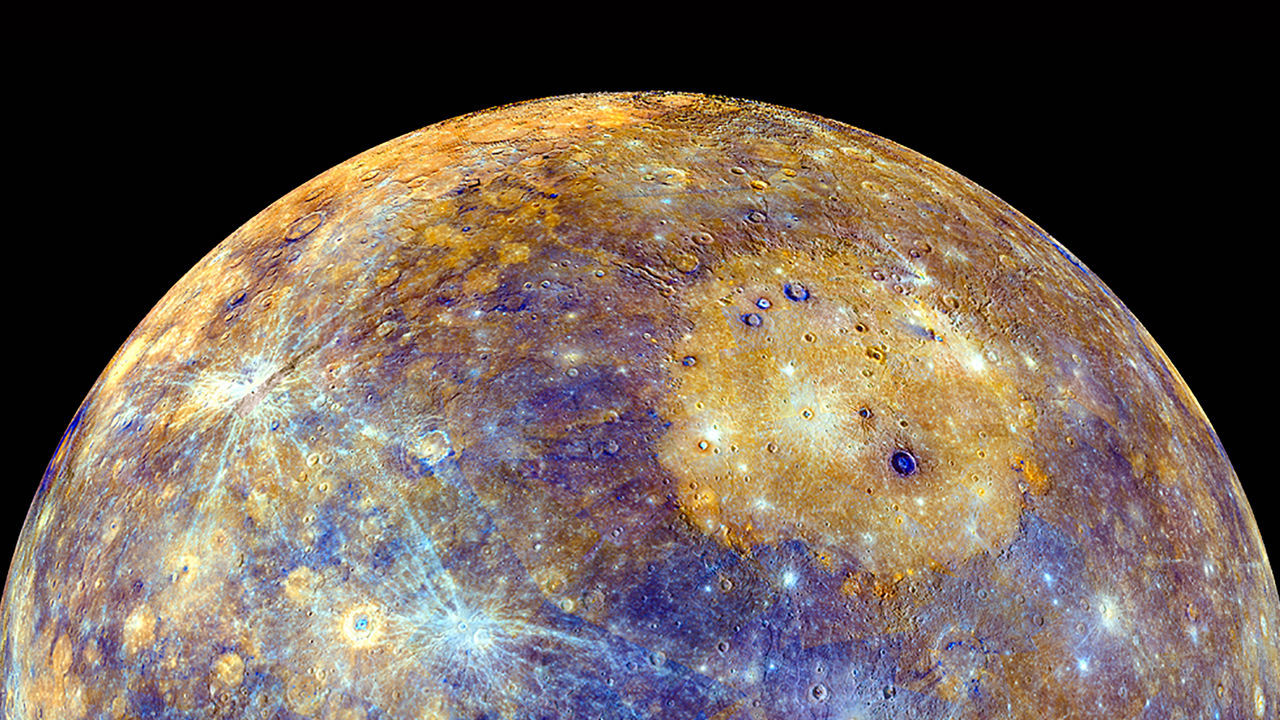
Apparently aliens are real and they have a base on Mercury
Plenty of people sit comfortably between total dismissal and total acceptance when it comes to unexplained phenomena. They leave room for possibilities that stretch beyond current knowledge while still waiting for evidence that can be examined and tested. That middle stance shows up often when the subject turns to extraterrestrial life. The odds that aliens are real somewhere out there feel reasonable to many. The odds that they maintain an active base on Mercury feel considerably less reasonable.
Claims linking visible structures on the innermost planet to alien construction have circulated for years. One version centers on a single photograph taken decades ago and the interpretations that followed. The story gained fresh attention in 2020 when ufologist Scott C. Waring presented the image as decisive proof. Most readers still want more than a single frame and an enthusiastic caption before they sign on.
Mercury sits so close to the Sun that surface conditions look hostile to anything resembling known biology. That does not stop speculation, though, and the question keeps resurfacing whenever new images or old anomalies reappear online. Here is the background that actually exists.
When did this begin?
Scott C. Waring first highlighted the image in coverage that appeared in Express UK in May 2020. He pointed to photography captured by NASA’s Mariner 10 spacecraft during its initial Mercury encounter on March 29, 1974. The frame in question shows terrain inside the Tolstoj quadrangle. Waring described the shot as infrared imagery that revealed features invisible to standard cameras and labeled it one hundred percent proof of life.
Mariner 10 carried an eight-position filter wheel, and one setting did record infrared data. No subsequent mission team or peer-reviewed study has identified artificial structures in that region or anywhere else on Mercury. The original photograph remains the sole piece of imagery tied to this particular claim.
When was this city supposedly built?
Waring argued that the visible pattern represented a city constructed thousands of years earlier by visitors who could control their own biology. He suggested their technology allowed them to adjust age and appearance at will, making long construction timelines irrelevant. In follow-up statements he added that the structures might actually lead underground, with large entrances visible in the low-resolution frame.
Those interpretations have not changed since the 2020 posts. Waring’s blog and the Express UK articles from that period remain the primary sources repeating the claim. No new photographs or independent analysis have been offered to support the reading.
What does the scientific community say?
Researchers classify the interpretation as a classic case of apophenia, the tendency to assign meaning to random patterns. The same impulse produces faces on the Moon or canals on Mars when image quality is limited. Mercury’s surface offers plenty of natural geology, including craters, scarps, and volcanic plains, that can resemble constructed forms at low resolution.
MESSENGER orbited the planet from 2011 to 2015 and returned high-resolution mapping along with compositional data. Those observations confirmed extreme surface temperatures, a negligible atmosphere, and no detectable water or organic signatures. No mission imagery has shown artificial structures or habitable zones. BepiColombo is scheduled to begin its orbital phase in November 2026 and should deliver still sharper views of the same terrain.
Later Missions and Higher-Resolution Views
Mariner 10 flew past Mercury three times in 1974 and 1975, returning the first close-up images of any planet inside Earth’s orbit. The data were groundbreaking for their era yet limited by 1970s camera technology and brief flyby windows. Later spacecraft changed the picture considerably.
NASA’s MESSENGER mission spent four years in orbit and produced global mosaics at resolutions far beyond anything Mariner 10 achieved. Those images mapped scarps, hollows, and volcanic plains across the Tolstoj region and elsewhere with no indication of constructed features. ESA and JAXA’s BepiColombo spacecraft has already returned additional flyby images in 2025, and its upcoming orbital campaign will add further detail beginning late next year.
Mercury’s Extreme Environment and Habitability Limits
Daytime temperatures on Mercury can exceed 800 degrees Fahrenheit while nighttime readings drop below minus 290 degrees. The planet lacks a substantial atmosphere to trap heat or moderate swings, and solar radiation reaches levels that would strip complex molecules from any exposed surface. Liquid water cannot persist under those conditions.
Multiple missions have measured the radiation environment and surface composition directly. Results show a thin exosphere of atoms kicked up by micrometeorites and solar wind, not a protective blanket. Any structure on the surface would face constant thermal stress and particle bombardment that current engineering has not solved for long-duration human or biological presence.
Broader Context of Pareidolia in Planetary Imaging
Low-resolution spacecraft photographs have triggered similar claims on several worlds. The famous “face” on Mars and assorted lunar anomalies followed the same pattern: limited pixels plus human pattern recognition produced structures that vanished under better cameras. Psychologists have documented the effect for decades in studies of image interpretation.
Mercury’s heavily cratered equatorial zones contain plenty of natural alignments that can look geometric when viewed from a distance. Higher-resolution data from MESSENGER replaced those suggestions with mapped geology. The same outcome has repeated across other bodies whenever follow-up imaging arrived.
UFO Claims and Official Investigations
Public interest in extraterrestrial visitation remains high. Recent polls continue to show that a majority of respondents believe intelligent life exists elsewhere in the universe. That belief has not translated into verified evidence of visits or bases within our solar system.
The Pentagon’s All-domain Anomaly Resolution Office has reviewed decades of UAP reports and found no confirmed examples of extraterrestrial technology. Claims about specific locations such as Mercury stay confined to enthusiast sites and have not produced supporting data accepted by mission scientists. Ongoing missions will continue to test surface interpretations with instruments far more capable than those carried by Mariner 10.
The middle-ground position still applies. Possibility remains open while evidence stays thin. Mercury’s next round of close-up photography should clarify whether any surface features deserve another look or whether the 1974 frame simply captured another stretch of ancient, sun-baked rock.
