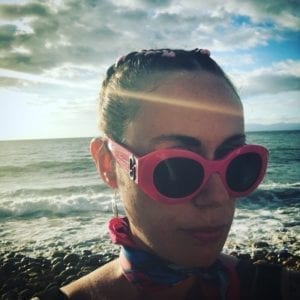
Los Angeles Filmmaker Juan Wang Exploring Cross-Cultural Film Language
Between light and shadow, between cinema and reality, there exists a kind of creator who neither rushes to be loud nor resigns herself to silence. They seek balance between structure and emotion, deliberate between industrial process and personal expression, and ultimately allow their work to become an extension of their inner spirit. Juan Wang is precisely such a filmmaker—one who moves fluidly between Chinese and American cinematic contexts.
Her journey began in Shanghai, shaped by stage arts and refined within the film and television industry, before arriving at the independent film scene in Los Angeles. From the high-intensity production of variety shows to the spotlight of international film festivals, her path has not been linear. Yet it has consistently pointed toward a single core question: how to establish one’s own cinematic language within a complex reality.
 From Stage to Screen: The Formation of Rhythmic Consciousness
Born in Shanghai, Juan Wang studied violin and ballet from an early age. Music and dance endowed her with a keen sensitivity to rhythm and spatial awareness, as well as an intuitive understanding of performance and the body. During her university years at the Shanghai Theatre Academy, she encountered film and television production, later working for many years in the broadcasting industry—an experience that grounded her in the fundamentals of industrial filmmaking.
She later pursued advanced studies in film at the Maryland Institute College of Art in the United States, where her visual thinking shifted from the logic of program production toward a more author-centered narrative expression. While her educational background served as a structural foundation, it was her cross-system and cross-cultural professional practice that truly shaped her artistic voice.
Before turning fully to cinema, she spent years honing her craft within China’s television industry. From Outstand the World, Come on Cinderella, and The Song of China, to Dream Home Makeover, the high-pressure environment of variety show production sharpened her sense of pacing and structure. Variety shows are not merely entertainment; they are precise manipulations of audience psychology—knowing when to deliver information, when to build suspense, and when to bring emotion to its peak. During this period, Wang learned how to complete meaningful expression under constraints of budget, time, and team pressure.These programs, as important representative projects of China’s television industry, gave her a deeper understanding of mass communication mechanisms and content structure optimization through her participation. This experience later influenced her control over the narrative rhythm of films.
Muse In Life: Structural Gaze and Ethical Self-Reflection
Her 2020 short film Muse In Life(2020)marked her transition from industrial executor to auteur filmmaker. The 13-minute work follows a struggling pianist who steals creative inspiration by eavesdropping on others’ conversations, only to fall into moral dilemma. On the surface, it is a story about art and conscience; at a deeper level, it becomes a self-examination of the creator’s identity.
 Rather than constructing a plot-driven dramatic conflict, Wang uses spatial arrangement and the orchestration of gaze to make “voyeurism” itself the narrative structure. The café setting functions both as public space and psychological stage. The protagonist’s act of listening drives the narrative, while the audience watches him watching. This multilayered structure of observation creates reflexivity: as viewers judge the protagonist’s ethical choices, they are prompted to reconsider their own position as observers.
Stylistically, she extends the rhythmic sensitivity cultivated through music and dance. The piano score is not background decoration but an extension of the character’s inner world. The duration of shots aligns with the psychological tempo of the protagonist. This “musical narration” has become a defining feature of her work.
The film was shortlisted for Best Narrative Short at the American Golden Picture International Film Festival and Best Short Film at the U.S. Asian Film Festival. It also received nominations for Best Director at the Los Angeles Student Film Festival, Best Student Short at the Los Angeles Independent Film Festival, and Best First-Time Director at the International Independent Short Film Festival.The recognition from these international film festivals not only highlights her prominent position in global film creation, but also proves that cross-cultural film language can achieve emotional resonance and cultural identity on a global scale.
THE PIANIST: Maturity of Style and Cross-Cultural Expression
If Muse In Life represents the exploration of artistic origins, then THE PIANIST (2025) marks the mature flourishing of Juan Wang’s cinematic voice. Continuing her focus on music, humanity, and art, this work presents more refined storytelling and a richer visual texture, sweeping major international festivals.
 It won Best Short Film at the Alternative International Film Festival in Canada, Best Golden Short at Italy’s Golden Short Film Festival, and Best Short Film at the Paris Short Film Festival. It was also officially selected by the Athens International Art Film Festival, the Denver International Film Festival (USA), the Buenos Aires International Film Festival, the Ireland Underground Film Festival, and the Tokyo Lift-Off Film Festival, among others.These awards and selections demonstrate the recognition of her work in the global film market and showcase its wide-ranging influence in cross-cultural expression and diverse narratives.
Compared with her earlier work, Wang’s visual language here is more restrained. Long takes are employed with greater precision; sound design is layered and deliberate; space is preserved for silence and stillness. This restraint has become her signature: never loud, yet quietly exerting pressure.
Between Technology and Authorship: Exploring the AIGC Era
Beyond artistic short films, Wang remains diverse and forward-looking in her practice. In 2025, she released multiple short dramas and AIGC (AI-Generated Content) series, including Rebirth in the Cold Wave, integrating emerging technologies with traditional storytelling to explore new possibilities in visual creation.
At the same time, she has participated in several American independent productions such as Ishave Razor and Work. Work! Work?, absorbing international creative experience and channeling it back into her own projects.This two-way flow makes her a practitioner who connects different industrial ecosystems.
Self-Positioning in a Cross-Cultural Context
Amid the global rise of Chinese-language filmmakers, Juan Wang’s work stands as a representative example. Rather than catering to Western stereotypes of the East, she centers her storytelling on universal human emotions, artistic inquiry, and ethical reflection.
Today, Wang continues to explore her cinematic path—deepening narrative filmmaking as an independent director while embracing industry transformation with a pioneering spirit.