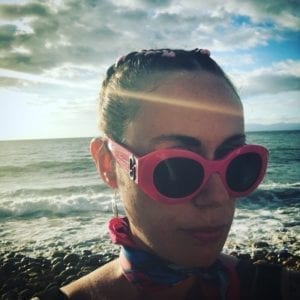
Lasley Lui is building an emotional empire, one silence at a time
Lasley Kam Shu Lui doesn’t just cut films—she scores the invisible. A Los Angeles–based editor and director, Lui has become known for the kind of storytelling that doesn’t beg attention but earns it. Her emotionally precise mini-series have since reached a vast global audience—bringing that same aesthetic into the mainstream.
 “I didn’t want to recreate Hong Kong literally, but to let its echo haunt the frame,” she says of After Dinner, her award-winning short that overlays the sounds of Hong Kong on New York visuals. That haunting, cross-cultural layering has become her signature.
“When I moved to New York, I was constantly projecting Hong Kong onto the city—especially in Chinatown.”
 After Dinner premiered at the New York Odyssey Film Festival, where it won both Best Short and the Odyssey Award. It was later selected by FilmColumbia—a prestigious U.S. festival known for curating standout films from Cannes, Venice, and the Oscars—and screened at the San Diego Asian Film Festival as well as other notable festivals across the country. The film’s quiet resonance has since positioned Lui as a distinct voice in emotionally-driven cinema.
Her decision to shoot memory sequences on Super 8 wasn’t aesthetic—it was emotional. “Super 8 gave those moments permission to feel precious but also fragile,” she explains. The grain, the blur, the softness—each frame becomes a vessel for tenderness, for half-remembered longing.
 “It softens the edges. It lets the past blur, which is how memory works anyway.”
Set in Chinatown and structured like a slow farewell, After Dinner centers on a breakup that resists clarity. “I wanted to capture that kind of farewell: the one that feels like a long walk home,” Lui says. It’s not resolution she’s after—it’s resonance.
“Chinatown felt like the perfect backdrop… layered, chaotic, nostalgic—it holds a kind of emotional density.”
 A master of restraint, Lui cuts with discipline. “I always ask myself, ‘What would happen if I just left this moment alone?’” she says of her editing process. Her silences aren’t voids—they’re loaded pauses.
“Silence, for me, is never empty—it’s charged.”
Sound, to Lui, is not subordinate to image—it’s a full emotional force. In The Normal Girl, she crafts an entire mother-daughter dynamic with no dialogue, only ambient noise. “It’s a soundscape of pressure,” she says. That pressure, that unspoken weight, drives her storytelling.
 “It tells you what the characters aren’t saying—what they’re holding in their bodies.”
The Normal Girl demanded a bodily kind of editing—cuts that could breathe and bruise. “Too smooth, and you lose the edge. Too jagged, and it becomes alienating,” she explains. The film’s tone lives in the friction between intimacy and discomfort.
“The goal wasn’t to make it polished, but to make it feel lived-in.”
Her journalism roots still shape her fictions. “I still think like a reporter,” she says. Research and interviews feed her emotional logic. The Normal Girl drew from real-life conversations with women who have PCOS. Their metaphors became her map.
“I start with listening.”
Directing and editing aren’t separate to her—they’re interwoven. “It’s like pre-editing in real time,” she says. This dual lens allows her to shoot only what she needs, giving each project clarity and efficiency.
“When I direct, I’m already thinking like an editor.”
Her short-form mini-series Baby Bump to Billionaire’s Wife, Food, Love, Robot, and The Captain’s Baby have collectively reached over 72 million views—but they’re not just snackable content. They’re rhythmic, emotionally precise structures. “In short-form, emotional shifts are everything,” she says.
“Each episode needs a tonal arc—a buildup, a release, and ideally, a moment that hits hard.”
Even under pressure, she protects feeling. “I lean into instinct,” she says of fast turnarounds. For Lui, every reaction shot, every pause is sacred. “It’s about making space for characters to feel like people, not just plot machines.”
“I protect those micro-moments of vulnerability.”
Genre isn’t a boundary—it’s a toolkit. In Food, Love, Robot, she lets the tone soften with time. In Baby Bump, she spikes the pace to match the emotional stakes. “The tone evolves with the protagonist,” she explains.
“Quicker pacing and more abrupt transitions matched the rising intensity.”
Even as her audience grows, she remains grounded in Hong Kong’s dualities. “That tension shows up in everything I make,” she says. Restraint, indirectness, unsaid emotion—these are her narrative compass points.
“I’m always aware of what’s being held back, what’s not being said.”
What’s missing in editing today? “The quiet ones,” Lui says. She’s uninterested in love stories that scream. Her loyalty is to daily intimacy, slow erosion, and quiet rupture. “Drama doesn’t always have to be loud.”
 “Sometimes it lives in the repetition of habits, in shared silences.”
She knows a cut is right when her brain switches off. “It feels less like editing and more like falling into rhythm with the characters.” At that point, the technical becomes emotional. The sequence breathes on its own.
“It’s the moment I stop thinking.”
Her experimental work, like How to Grow an Avocado Tree, lets her train in intuition. “It’s like creative cross-training,” she says. These projects give her license to break the rules—then return sharper.
“The freedom of that process sharpens my instincts.”
Women’s stories require precision and perspective. “It’s less about what’s said, and more about what simmers beneath,” she explains. With quiet close-ups and restrained tension, she channels the slow-build legacy of filmmakers like Chantal Akerman.
 “Tension through observation.”
Even she gets surprised. The Normal Girl left her emotionally raw in post. “That intensity surprised me, but I think it was needed,” she says. Editing it wasn’t just technique—it was catharsis.
“It made her story impossible to look away from.”
If she could cut anyone’s work? Jia Zhangke. “To sit with his raw footage would be like reading an unfinished novel you get to help shape,” she says. His emotional honesty mirrors her own pursuit.
“His stories feel both grounded and poetic.”
Editing’s real magic, Lui says, is in knowing when not to intervene. “It’s a space for feeling, imagining, projecting.” The invisible edit isn’t a lack—it’s an invitation.
“Sometimes what’s not said carries the most weight.”
 —
—
Explore more from Lasley Lui
Website: https://lasleylui.com/