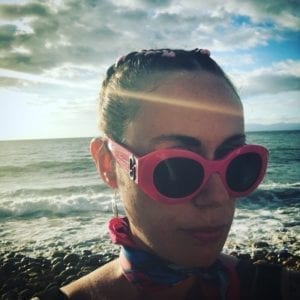
Huiyu Zhou on the sharp humor and quiet rebellion of Best Mom Ever
In Best Mom Ever, editor Huiyu Zhou cuts with precision, empathy, and rebellion. The short film—directed by Chaewon Suh and produced by Isioma Oramah—turns the familiar story of a mother returning to work into a biting, darkly comic critique of modern patriarchy. What begins as satire slowly shifts into an unflinching study of exhaustion, sacrifice, and identity. It’s the kind of tonal balancing act that demands both discipline and instinct—qualities Zhou has in abundance.
The project originated two years ago when Suh brought Zhou the idea. “The initial version is a comedy, but there are several conversations that are very serious,” Zhou recalls. “I was wondering if we could make the overall storytelling similar to Fleabag.” Through multiple rewrites, that impulse crystallized into something “sharp but very hilarious at the same time.” The result feels universal but unmistakably female: a mirror held up to the impossible performance of working motherhood.
For Zhou, collaboration with Suh and Oramah was central. “One good thing about teaming up with Chaewon is that she is a really good listener,” she says. “She knows what she wants and pays attention to her art visionary, but she won’t force you to 100% follow her orders.” That freedom shaped the cut’s rhythm and tone. “It’s the good communication within the team that makes the project go so well.”
 Uncover the hidden truth
 Uncover the hidden truth
That open process led to the film’s most pivotal evolution—from breezy workplace comedy to grounded domestic tension. “We didn’t intentionally make the whole storytelling into grounded drama,” Zhou explains. “It’s much more like a result of changing the overall editing pacing.” By slowing certain sequences and allowing emotional space, she and Suh uncovered a deeper truth: “Sometimes this bold change could be a disaster, but sometimes it brings unexpected effects.”
Pacing, in fact, became the heartbeat of Best Mom Ever. “We want to make the overall workplace vibe as real as possible,” Zhou says. “The daily routine gets quick, and the pacing gets slow when we want to dig into humanity.” That same precision carries into the climactic argument between Ali and her husband—what Zhou calls “the most important part for revealing the unbalance inside a family.” It’s a scene, she notes, that “surprisingly didn’t change so much from the beginning to the end,” built on the fracture between trust and expectation.
Even the title carries irony. “The logo for the mug at the end of the film is Best Mom Ever,” Zhou says. “I suggested that if we want to make the overall film sarcastically, it could be a good title to use.” When audiences whisper during that final shot, she knows the choice landed: “It means my insistence on using the name Best Mom Ever actually works.”
 Unlock hidden depths
Zhou’s design background grounds her visual intuition. “The overall creation process is much more like drawing different kinds of circles from one point,” she says. “The design background knowledge is this unshakable point.” Her greatest creative battles still circle back to pacing—“I like to do slow pacing to narrate a story”—a tension that led to six script versions and fierce debates about tempo.
Editing such emotionally loaded material demanded restraint. “It reminds me of stories from my mom, grandmom, and aunt,” she says. “They are women who have strong personalities but make sacrifices for family.” That awareness of generational weight deepens the film’s critique of patriarchy: “We offer a different perspective to see the inner structure of the family and society. When the voice gets louder and louder from different groups, it becomes a strength.”
The closing shot—“the mug”—remains her favorite transformation. “Slow pacing could have strong power for storytelling,” she reflects. “Slow means let the emotion express.”
Discover new perspectives
 Discover new perspectives
Now an award-winning short, Best Mom Ever continues to resonate. “We didn’t expect to get the award,” Zhou says. “It’s a surprise, and we get excited.” Yet her motivation remains rooted in conviction: “If I can catch a chance to cut a film related to gender and identity, I definitely will—because we live in a world that needs different voices now.”