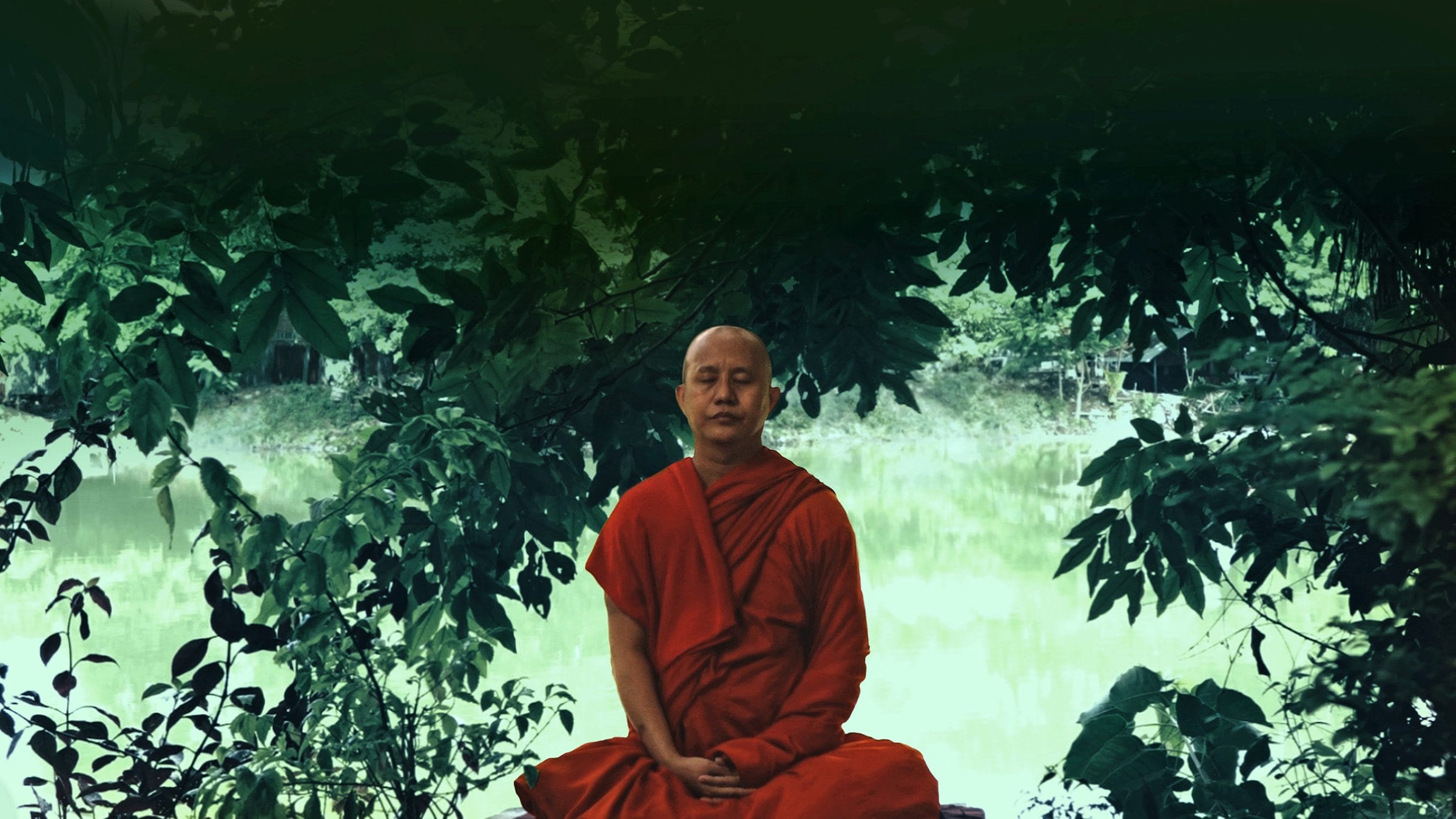
“The Face of Buddhist Terror” in ‘The Venerable W.’
Barbet Schroeder’s documentary The Venerable W. reached Cannes in 2017 and closed out the director’s Trilogy of Evil, a project that began with General Idi Amin Dada in 1974 and continued with Terror’s Advocate in 2007.
Schroeder traveled to Burma to examine how everyday prejudice and public hate speech could turn into open violence inside a country that is 90 percent Buddhist, a faith long associated with peace and restraint.
The film centers on Ashin Wirathu, a monk whose sermons mixed religious authority with nationalist rhetoric and who once praised Donald Trump as the only candidate who could guarantee American safety.
Time magazine placed Wirathu on its cover in 2013 under the headline “The Face of Buddhist Terror,” a label that followed him into international reporting for years.
Release Information
Theatrical release in France took place in June 2017. After festival screenings the film moved into wider distribution and now appears on major streaming services. Viewers can currently find it on Prime Video and other platforms, with an additional slot on Philo scheduled for July 2026. It has also played at the Museum of Modern Art and the Jerusalem Film Festival, keeping the subject in circulation more than eight years after its debut.
Subject Background
Wirathu surrendered to authorities in 2020. Myanmar’s military junta released him in September 2021 after dropping sedition charges. In 2022 the junta awarded him the honorific title Thiri Pyanchi. He has remained visible in nationalist circles and has publicly endorsed the regime’s political plans into 2026, showing that the tensions the film recorded did not fade after cameras stopped rolling.
Context of the Rohingya Situation
The Yale Law School report that prompted Schroeder to start filming had already warned of genocide against the Rohingya, a Muslim minority concentrated in Rakhine State. A mass exodus of roughly 742,000 people occurred in 2017, adding to earlier refugee flows. Today more than 1.3 million Rohingya live in camps across the border in Bangladesh. Following the 2021 coup, renewed fighting has displaced additional civilians, and international legal proceedings continue while the military holds roughly 21 percent of the country’s territory.
Wirathu’s Post-Film Trajectory
After the documentary’s release, Wirathu stayed aligned with military interests. His 2021 freedom and subsequent national title allowed him to resume public appearances. Reports from 2025 and 2026 show him still active in ultranationalist Buddhist networks that support junta policies, illustrating how the figure at the center of Schroeder’s portrait retained influence long after the film reached audiences.
Availability and Legacy of The Venerable W.
Streaming access has replaced the limited 2017 rollout. The film sits on Prime Video and Kanopy, with Philo adding it next summer. Festival programmers continue to schedule it in retrospectives, including recent presentations at MoMA. Its endurance on these platforms keeps the record of early anti-Rohingya incitement available to new viewers who encounter the same patterns in later news coverage.
Ongoing Rohingya Crisis and Buddhist Nationalism
The civil war that intensified after the 2021 coup has left large parts of Myanmar outside central control. Ultranationalist monks have kept public platforms alongside the military, echoing the rhetoric captured in The Venerable W. Refugee numbers in Bangladesh remain above 1.3 million, and cross-border violence in Rakhine State persists. International courts continue to review evidence of crimes committed since the period the documentary first examined.
Schroeder’s Trilogy of Evil in Retrospect
Schroeder completed the trilogy with The Venerable W. in 2017. Across all three films he relied on the same method: extended access to central figures without immediate commentary. The approach lets viewers watch statements and actions accumulate. The final entry still appears in festival programs that revisit the trilogy, confirming that the director’s method of letting subjects reveal their own positions has retained its value for audiences studying how rhetoric and power intersect.
Schroeder has described Buddhism as an atheist tradition open to pessimism, a view that drew him to the subject in the first place. He has also credited Hans Wolfgang Schumann’s book The Historical Buddha as essential reading that sharpened his focus. Those remarks remain part of the record that accompanies the film wherever it screens today.