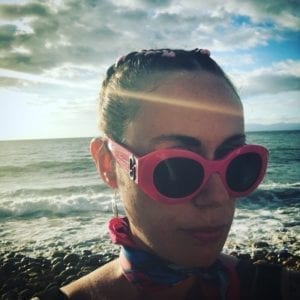
Yifan Du: The Editorial Vision Behind Atlante’s Mistaken Fiancée
Yifan Du: The Editorial Vision Behind Atlante’s Mistaken Fiancée
In a field driven by speed and spectacle, Yifan Du stands out for her precision and narrative instinct. As both producer and editing supervisor of the breakout vertical drama Atlante’s Mistaken Fiancée, she helped shape one of the year’s most-watched digital series. This project not only topped global short-drama charts but also raised the creative standard for a rapidly emerging format.
 Untested vertical drama comes to america
 Untested vertical drama comes to america
The opportunity arrived almost by accident. In late 2023, an executive producer from a vertical mini-series platform approached Du about producing and editing a show in the United States, where the format was still untested. While vertical dramas had exploded across China, few American teams had explored them, and even fewer had localized them for Western audiences. “There weren’t many people doing this here,” Du recalls. “Most platforms were still sending footage back to China for post-production. I wanted to show that we could build this from the ground up in the U.S.”
Her decision placed her among the pioneering editors in the U.S. exploring the vertical format—a medium still defining its visual language. Atlante’s Mistaken Fiancée served as her proving ground, an ambitious 80-episode production that required the precision of film craft within the constraints of a phone screen. During a month of pre-production, Du expertly managed a team of script translators, cultural adaptors, casting professionals, and look development specialists, fine-tuning the show’s tone to harmonize Eastern storytelling rhythms with Western sensibilities. The outcome was a dynamic, fast-paced series characterized by workplace tension and emotional twists, all designed for maximum impact within a vertical frame.
Production put that vision to the test sooner than expected. Filming began in February 2024, just as Los Angeles was drenched in a week of rain that threatened to shut everything down — including a key golf-course sequence that couldn’t be replicated indoors. “It wasn’t something we could fake,” Du says. “We needed sunlight, open space, and movement.” She negotiated with the cast and crew to pause for two days, betting on a brief break in the storm. When the sun finally returned, the team moved fast to capture the scene — footage that would later become one of the show’s signature visuals.
 If production was about adaptability, post-production was about endurance. The schedule allowed just one month for editing, color, music, and subtitles—a feature-length workload condensed into weeks. When an additional editor fell behind, Du took over the bulk of the cut herself, often working overnight to meet the platform’s tight release deadlines. “We were aiming for five to eight episodes a day,” she says. “I had to make sure every frame hit the emotional beat without losing pace.”
Years of work have tuned Yifan Du’s precision into instinct — the kind that comes from editing across formats, learning how rhythm and restraint can turn simple scenes into a cinematic presence. With a background that spans short films, trailers, and commercials, Du approaches editing like music—intuitive, measured, and alive. “Editing has its own rhythm,” she explains. “You feel when a scene should breathe and when it should move.” That sensibility, shaped by her training in piano, guitar, and bass, guides her approach to tone and pacing. Romantic moments unfold with lingering warmth and softness; workplace confrontations cut fast, built from shifting angles and sharp transitions. “It’s all about emotional rhythm,” she says. “If the cuts move too quickly, the feeling disappears. If they’re too slow, the story loses its pull.”
 Yifan Du with DIT
Du also worked closely with the director and writer to maintain story cohesion across the 80-episode arc. Every cliffhanger and reaction shot was calibrated to sustain the momentum that drives short-form viewing. “We treated it like a traditional series compressed into minutes,” she says. “You still need arcs, payoffs, and pacing.”
Released in 2024, Atlante’s Mistaken Fiancée quickly became a digital phenomenon. Its blend of brisk storytelling and relatable workplace themes struck a chord with audiences worldwide, propelling it to more than 27 million views and the top of multiple vertical-drama rankings. The series was soon translated into Spanish and Russian and distributed across several countries — a rare global reach for a project produced entirely in the U.S.
 Yifan Du (right side) with director, Anabelle D. Munro (Left side)
The show’s success wasn’t just about numbers. For many in the industry, it signaled a turning point — evidence that vertical storytelling could command the same attention, discipline, and commercial value as traditional streaming series. Executives across short-form platforms began citing Atlante’s Mistaken Fiancée as a benchmark for pacing and production quality. “It showed that vertical drama doesn’t have to feel disposable,” said one producer familiar with the genre, speaking on condition of anonymity because of platform ties. “It proved you could deliver cinematic storytelling inside a one-minute frame.”
Du’s editorial approach became part of that conversation. Her ability to balance emotion with tempo helped define a new aesthetic for short dramas — one that prioritized rhythm and restraint over gimmickry. The project’s streamlined post-production model, which kept all editing and sound work local, also demonstrated that vertical dramas could be produced efficiently within the U.S. system, avoiding the overseas post pipelines that had long defined the format.
Beyond its popularity, the series served as a proof of concept: cinematic storytelling could thrive within the constraints of a vertical frame. Its commercial and critical success demonstrated that audiences still crave emotional depth, even in the briefest formats—and that disciplined editing can deliver it. “People still want stories that move them,” Du says. “They just want to feel it faster.”
Since Atlante’s Mistaken Fiancée, Du has continued to explore the space between immediacy and immersion, developing projects that test how much emotional depth can live inside short-form storytelling. Colleagues describe her as meticulous yet instinctive — an editor who treats rhythm as narrative, not decoration. To her, the vertical frame isn’t a constraint but a new kind of stage, one where intimacy replaces scale.
As the format evolves and new platforms rush to capture its audience, Du’s work remains a reference point — not because it broke records, but because it proved that storytelling discipline still matters, no matter the screen size. And as vertical storytelling moves from trend to global standard, her precision-driven approach offers a model for what this medium can be — less about the novelty of format, more about the enduring craft of emotion, rhythm, and connection.
You can follow Yifan Du at the following social media links